Turkish SIM Card and eSIM Guide 2026: The Complete Tourist Data Plan Handbook

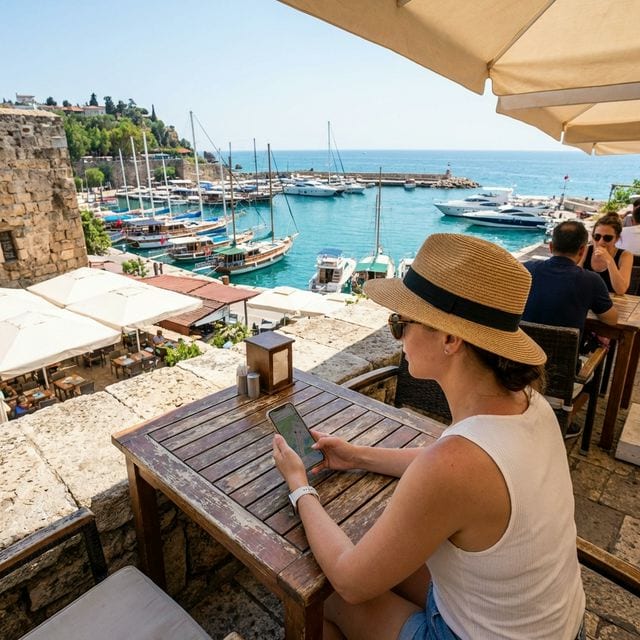
Tourist using smartphone at Antalya harbor with Mediterranean view
Landing in Antalya without a working data connection is one of those small travel frustrations that snowballs fast. You cannot open your ride app, you cannot check the exact meeting point your driver sent you, you cannot pull up your hotel confirmation, and the airport WiFi login screen wants a phone number you cannot receive a code on yet. None of this is complicated to avoid, but it does require knowing, before you fly, which of the three Turkish networks to use, whether a physical SIM or an eSIM suits your trip better, and — the one detail almost nobody explains properly — how Turkey's IMEI registration rule actually works and why it is nothing to worry about for a normal holiday.
This guide replaces the old, thin version of this article with something built for people actually standing in the arrivals hall at Antalya Airport (AYT), phone in hand, trying to make a decision in the next ten minutes. We cover all three Turkish operators, the eSIM providers worth using, the exact mechanics of the 120-day IMEI rule, realistic data plan sizes, top-up methods, roaming costs by home country, the truth about free WiFi in Turkey, and a full FAQ section for the questions people search for most.
Why Data From Minute One Actually Matters
It is easy to underestimate how much a working connection changes the first hour of a Turkey trip. The moment you land, a phone with data lets you do several things back to back, without hunting for WiFi passwords or standing in a queue at a kiosk:
- Open Google Maps or Maps.me to orient yourself inside a large, sometimes confusing terminal
- Message your hotel or host to confirm arrival timing
- Use a translation app if you need to read a sign, a menu, or a form
- Open a ride-hailing or taxi app if that is your plan for getting into the city
- Check in with family or friends that you have landed safely
If you have booked a private transfer in advance, the calculus is a little different and genuinely simpler: your driver already has your flight number, is tracking the actual landing time rather than the scheduled one, and will be holding a name board in arrivals regardless of whether your phone has signal yet. The one place data still helps is confirming the exact meeting spot by WhatsApp — a quick message the moment you land, once you have a connection, smooths out what could otherwise be a few minutes of scanning faces in a crowded hall. It is not a requirement for the transfer to work, just a convenience layer once you have connectivity, whether that comes from an eSIM already active in airplane mode or a SIM bought at the counter fifteen minutes earlier.
Either way, the sooner you are connected, the sooner Antalya stops feeling unfamiliar and starts feeling manageable.
The Three Turkish Mobile Operators — Which One Should You Choose
Turkey has three nationwide mobile networks, and all three sell dedicated tourist packages aimed at foreign visitors. None of them require a Turkish ID number or tax number for a short-term tourist SIM — a valid passport is the only document you need, and by law it is checked and recorded for every SIM sold in the country, to tourists and residents alike.
Turkcell — Best Coverage, Premium Price
Turkcell is Turkey's largest and oldest operator, and it shows in coverage: the strongest signal in rural stretches of the Turkish Riviera, mountain villages inland from Antalya, and along less-traveled coastal roads where a weaker network might drop to 3G or disappear altogether. It is consistently the most expensive of the three, but for travelers heading beyond the main resort strip — day trips to Termessos, the Taurus Mountains, or smaller towns along the coast — that reliability is often worth paying for. Turkcell tourist SIM kiosks are present at Antalya Airport arrivals and in branded shops throughout the city center, including Kaleiçi and the main shopping districts.
Vodafone Turkey — Balanced Coverage and Price
Vodafone sits in the middle on both coverage and cost. Around Antalya, Belek, Side, Kemer, and the other major resort areas, the difference in practice between Vodafone and Turkcell is minor — you are unlikely to notice a gap in service unless you are specifically going off the beaten path. Vodafone's tourist packages are competitively priced and its shops are just as widespread as Turkcell's near tourist zones, making it a sensible default for a standard beach holiday that stays within the main coastal belt.
Türk Telekom — Best Value, Slightly Narrower Rural Reach
Türk Telekom (sometimes shown as Turk Telekom or TT) generally offers the most data for the price among the three, which makes it popular with budget-conscious travelers and longer-stay visitors buying larger packages. Coverage in cities and resort areas is solid; the trade-off shows up mainly in more remote, mountainous, or sparsely populated regions, where signal can be a notch weaker than Turkcell's. For a tourist staying within Antalya, Lara, Konyaaltı, or the nearby coastal towns, this rarely matters.
Operator Comparison Table
| Operator | Coverage Quality | Price Tier | Best For | Where to Buy |
|---|---|---|---|---|
| Turkcell | Widest, strongest in rural/remote areas | Highest | Travelers exploring inland, mountains, road trips | AYT arrivals kiosk, city center shops nationwide |
| Vodafone Turkey | Strong in cities and resort areas | Mid-range | Standard beach holidays, resort-based stays | AYT arrivals kiosk, shops in all major districts |
| Türk Telekom | Good in cities, slightly weaker in remote spots | Best value | Budget travelers, longer stays, large data needs | AYT arrivals kiosk, city center shops and bayi kiosks |
The IMEI Registration Rule — What Every Tourist Actually Needs to Know
This is the single most misunderstood topic in Turkish mobile connectivity, and it deserves a full, careful explanation rather than a one-line warning — because the short version tourists hear online ("your phone will get blocked in Turkey") is technically true but almost always irrelevant to their actual trip.
What the Rule Actually Says
Turkey requires every mobile phone actively used on a Turkish mobile network to have its IMEI (the unique hardware identifier baked into every phone) registered in the national telecom database. This is a long-standing anti-smuggling and tax-compliance measure, not something aimed at tourists. The rule kicks in the moment a foreign-registered phone — meaning a phone purchased outside Turkey — connects to a Turkish SIM for calls or data.
The 120-Day Grace Period
Here is the part that matters for almost everyone reading this: a foreign phone is allowed to run on Turkish networks for up to 120 days, counted cumulatively from the first time it connects with a Turkish SIM. During that window, everything works completely normally — calls, texts, and data, exactly as if the phone were locally registered.
Only after the phone has accumulated 120 days of use on Turkish mobile networks does the restriction actually trigger. At that point, the device is permanently blocked from Turkish mobile networks — no calls, no mobile data, no SMS through the local network. WiFi is entirely unaffected, since WiFi has nothing to do with mobile network registration; you would still be able to use the internet over WiFi indefinitely.
Who Is Affected — and Who Is Not
If you are visiting Turkey for a standard holiday of one, two, or even several weeks, this rule is not something to worry about at all. You are nowhere close to the 120-day threshold, and the countdown only matters if you are cumulatively approaching four months of usage on a Turkish SIM with the same foreign phone.
The people who genuinely need to plan around this are:
- Digital nomads and remote workers spending an extended season in Antalya
- Second-home owners who split their year between Turkey and elsewhere
- Long-stay retirees on extended tourist or residence visas
- Anyone repeatedly re-entering Turkey and reusing the same foreign phone with local SIMs over many months
How Registration Works If You Need It
If you do expect to exceed 120 days on the same foreign-bought phone, you can register the IMEI permanently through the government e-Devlet portal or in person at a tax office (Vergi Dairesi). A government registration fee applies — the exact amount is adjusted periodically, so check the current rate directly via e-Devlet or your nearest tax office rather than relying on any number quoted online, including this article. Once registered, the phone is treated the same as a Turkish-bought device and the 120-day limit no longer applies to it.
How eSIMs Fit Into This Picture
This is where a lot of confusion comes from, so it is worth being precise. The IMEI restriction is tied to the device itself, not to the SIM or line you put in it. A tourist using any kind of SIM — a physical Turkish tourist SIM, or a data eSIM from an international provider running on Turkish network infrastructure — is completely fine within the 120-day window, exactly like anyone else.
In practice, eSIM data plans from providers like Airalo, Holafly, Nomad, and Saily are typically sold and routed as short-term visitor data services, and the exposure to the IMEI rule is almost never a practical concern for someone using one of these for a normal trip length. The only scenario where the rule genuinely bites is the long-stay one described above: the same foreign phone, on Turkish mobile networks, via any SIM type, for more than 120 cumulative days without formal registration. For a two-week beach holiday, an eSIM, a Turkcell tourist SIM, or a Vodafone tourist SIM are all equally unaffected.
The Bottom Line
Do not let this rule scare you off buying a local SIM or eSIM — it is designed for a completely different problem, people permanently importing phones without paying registration duties, and a short-term visitor will never encounter it in practice. If your trip runs under four months, you can stop thinking about it entirely.
For more on what to sort out before you fly, including passport and entry requirements, see this Turkey e-visa and entry requirements guide, and for a broader first-timer's overview covering money, safety, and culture alongside connectivity, this first-time Turkey visitor guide is worth reading before departure.
Buying a SIM at the Airport vs in Town
Both routes work well; which one suits you depends on how much you value instant connectivity versus a slightly better price.
Planning your trip?
Enter your exact route and vehicle type to see the current booking price before confirmation.
Buying at Antalya Airport (AYT)
All three operators — Turkcell, Vodafone, and Türk Telekom — have staffed counters or kiosks in the AYT arrivals hall, alongside international eSIM vending points for providers like Airalo. This is the fastest path to connectivity:
1. Clear passport control and collect your luggage 2. Walk to the operator counter of your choice — they are clustered together, easy to compare on the spot 3. Present your passport, a legal requirement for every SIM sold in Turkey 4. Choose a data package — staff at the airport counters are generally comfortable working in English 5. The SIM is activated immediately, on the spot, before you leave the terminal
The trade-off is price: airport SIM packages tend to run somewhat higher than the same or similar package bought in town, reflecting the convenience and prime real estate of an arrivals-hall kiosk. Exact pricing is price on request at each counter, since operators run frequent promotional changes. Travelers who want the full picture of what else is in the terminal, from lounges to onward transport, can check our Antalya Airport arrivals and terminals guide before landing.
Buying in Town
Every Turkish city has Turkcell, Vodafone, and Türk Telekom branded shops, plus many supermarkets and corner shops (bayi) that sell prepaid starter packs over the counter. Buying in town is typically cheaper and gives you a wider selection of plans to compare side by side, since staff are not limited to an airport-specific package list.
The catch is logistics: you need a way to reach a shop, which usually means you already have some form of transport sorted — a private transfer, taxi, or public transport — before you can get connected, a bit of a chicken-and-egg situation if you were relying on data to arrange that transport in the first place. Shops in tourist-heavy neighborhoods are generally used to foreign customers and comfortable in English; shops further from tourist zones may be busier and less English-fluent, though the passport-and-package process is identical everywhere. If you plan to explore the wider city once connected, our Antalya public transport guide covering the tram, bus, and dolmuş network is a useful companion piece.
Passport requirement applies universally — by Turkish law, every SIM card, prepaid or postpaid, must be registered to an identity document, foreigner or citizen, no exceptions, no workarounds.
eSIM for Turkey — How It Works and Which Provider to Choose
An eSIM is a digital SIM profile installed directly onto your phone via a QR code or provider app, with no physical card involved. For a growing number of travelers, it has become the default way to get connected in a new country, and Turkey is well served by international eSIM providers.
Device Compatibility
eSIM support depends on your specific phone model and, for iPhones, on the phone being carrier-unlocked. As a general guide:
- iPhone XS and later generally support eSIM, subject to your phone being unlocked
- Most Android flagships from roughly 2019 onward support eSIM, including Samsung Galaxy S20 and later, and Google Pixel 3 and later
Because eSIM support varies by exact model, region of purchase, and carrier lock status, check your specific device before booking a plan — providers like Airalo publish compatibility checkers on their sites that take the guesswork out of it.
Popular International eSIM Providers for Turkey
| Provider | Plan Style | Local Phone Number | Notes |
|---|---|---|---|
| Airalo | Wide range of data sizes and validity periods | Usually data-only, some options add a number | Large country and regional catalog, easy app |
| Holafly | Flat-price unlimited data by number of days | Data-only | Simple pricing model, popular for longer trips |
| Nomad | Tiered data plans by size and validity | Data-only | Straightforward app-based top-ups |
| Saily (by Nord Security) | Tiered data plans | Data-only | Backed by a well-known security and VPN company |
| Maya Mobile | Regional and country-specific data plans | Data-only, select add-ons vary | Good for multi-country itineraries |
Activate Before Arrival, Not Before Departure
Most eSIM apps let you install the profile before you fly but delay activation until you actually land — this is the setting you want. Installing early means the eSIM is sitting ready on your phone the moment you touch down; activating only on arrival means you are not burning validity days while you are still packing your bags at home. Put your phone in airplane mode for the flight with the eSIM installed, then switch it on and activate as soon as you land, and you can realistically have data before you have even reached passport control.
eSIM Pros and Cons
Pros: - Instant setup with no queue at any counter - No physical card to lose, damage, or have swapped - Easy in-app top-ups without hunting for a shop - Can be installed before departure and activated the moment you land
Cons: - Data-only in most cases, meaning no real local phone number for calls or SMS, so you will rely on WhatsApp or another VoIP app for calls, and some Turkish services that send SMS verification codes may be awkward without a local number - Can be marginally throttled compared to a native carrier's own tourist SIM in some cases - Coverage in remote mountain or rural areas can be a notch weaker than a native Turkcell SIM - Not straightforward to add local voice minutes
Physical Tourist SIM Pros and Cons
Pros: - A real Turkish phone number, useful for hotel bookings, ride-hailing apps, and any Turkish service requiring SMS verification - Full voice minutes bundled with most tourist packages - Sometimes a larger data allowance for the price than an equivalent eSIM plan - Native network priority during the busy summer season
Cons: - Requires a shop visit and your passport in hand - Possible queueing during July and August peak season - A physical card can be lost or damaged during the trip
eSIM vs Physical SIM vs Home-Carrier Roaming — Quick Comparison
| Option | Setup Effort | Typical Cost Position | Local Phone Number | Best For |
|---|---|---|---|---|
| International eSIM (Airalo, Holafly, etc.) | Very low, install before flying and activate on landing | Competitive, plan-dependent | Usually no | Tech-comfortable travelers wanting instant data |
| Physical tourist SIM (Turkcell/Vodafone/Türk Telekom) | Moderate, shop visit and passport required | Competitive, often better value bought in town | Yes | Travelers who want a real Turkish number and voice minutes |
| Home-carrier roaming | None, works automatically | Usually the most expensive per gigabyte | Yes, your existing number | Very short trips or emergency-only connectivity |
How Much Data Do You Actually Need
Tourist packages are generally sold in a handful of standard sizes, with validity windows of 7, 14, or 28 to 30 days matching typical trip lengths.
- Light use, roughly 1–5 GB: Suits a short weekend trip, or a traveler who relies mainly on hotel and cafe WiFi and only needs maps, messaging, and occasional browsing on mobile data.
- Standard use, roughly 10–30 GB: The right range for most one- to two-week holidays involving regular maps navigation, social media, messaging, some music or podcast streaming, and light video calls.
- Large or unlimited-style, unlimited or 50GB+: Aimed at long stays or heavy streamers, with daily video calls, streaming shows on the go, or working remotely for part of the trip.
If you are unsure, standard-tier plans are the safer default for a typical Antalya holiday; running out of data mid-trip is a minor inconvenience, but overbuying a huge package you never use is simply wasted spend.
Topping Up and Recharging — Every Method
Running low on data mid-trip is easy to fix, and Turkish operators offer several ways to do it:
- Operator apps: Turkcell Uygulaması, Vodafone Yanımda, and the Türk Telekom app all have English-language interface options and let you buy add-on packages or renew your plan in a couple of taps.
- USSD codes: Each operator has a short dial code, typically in the *123# style, that brings up a menu for balance checks and package purchases. This exists and works, but most tourists find the app route more intuitive since it is entirely visual and in English.
- Corner shops (bayi): Independent mobile phone and telecom shops throughout every city can top up your balance or activate a new package for cash, no app required.
- Bank or credit card online: All three operators support direct online top-up through their websites using an international card.
- eSIM provider apps: If you are on an Airalo, Holafly, Nomad, Saily, or Maya Mobile eSIM, top-ups happen entirely inside that provider's own app — you do not interact with the Turkish operator directly at all for renewals.
Planning your trip?
Enter your exact route and vehicle type to see the current booking price before confirmation.
Roaming vs Buying Local — What Actually Makes Sense
Whether it is cheaper to roam on your home plan or buy a Turkish SIM or eSIM depends heavily on where you are traveling from, since Turkey sits outside several roaming frameworks that many travelers assume apply everywhere.
For EU Travelers
Turkey is not an EU member state, so the EU's "Roam Like At Home" rules, which cap or eliminate roaming charges inside the EU/EEA, do not extend to Turkey. EU carriers generally treat Turkey as a non-EU roaming destination and can charge noticeably more than intra-EU roaming would suggest, though a growing number of EU carriers now include Turkey within optional roaming add-on passes. The practical move is to check your specific home carrier's Turkey roaming terms before you fly, rather than assume EU-internal rates apply.
For UK Travelers
Since Brexit, UK carriers generally treat Turkey as a standard international roaming destination rather than a discounted one. Many UK carriers do offer optional daily roaming passes for Turkey at a flat add-on fee — the exact rate varies by provider and changes over time, so check directly with your carrier rather than relying on a number you saw somewhere online. For most UK travelers staying more than a few days, a local Turkish SIM or eSIM tends to work out more economical than a daily roaming pass stacked across a full week or two.
For Russian Travelers
Turkey is consistently one of the most popular destinations for Russian tourists, and this is an area worth being direct about: roaming with Russian carriers such as MTS, Beeline, Megafon, or Tele2 while in Turkey tends to be expensive on a per-megabyte basis. For any stay beyond a couple of days, buying a local Turkish tourist SIM or an international eSIM on arrival is nearly always the cheaper option compared with continuing to roam on a Russian home plan. Given how data-heavy a modern smartphone trip tends to be, with maps, messaging, translation, photos, and video calls home, the savings add up quickly.
Free WiFi in Turkey — What's Real and What's Oversold
Free WiFi exists widely across Antalya and Turkey generally, but the experience varies enough that it should not be your only connectivity plan.
- Antalya Airport: Free WiFi is available, but sessions are time-limited and registration sometimes requires a passport number or a boarding pass code — workable, but not instant, and not a substitute for having your own data once you leave the terminal.
- Hotels: Most 3-star and above properties offer free WiFi in rooms or common areas. Quality varies significantly — newer hotels tend to have solid coverage throughout, while some older resorts have noticeably weaker signal in rooms far from the router, especially in larger complexes.
- Cafes: Major chains like Starbucks and larger local cafe chains offer free WiFi, typically with a password available from staff on request.
- Shopping malls: Most malls provide free WiFi, but usually require a quick registration step, often an SMS verification code sent to a phone number. This creates a genuine chicken-and-egg problem if you have no local number yet and are relying on the mall's WiFi to get your first connection of the day, another good reason to sort out a SIM or eSIM before you need it rather than after.
- Restaurants, especially in old town areas like Kaleiçi: Coverage is inconsistent. Some have reliable free WiFi with the password posted on a menu or wall; others have none at all. Do not count on it as a backup plan in the old town specifically.
The overall picture: free WiFi is genuinely useful as a supplement, particularly in hotels, but it is patchy enough, and gated by registration hurdles at exactly the moments you need it most, like the airport and malls, that having your own mobile data remains the more reliable baseline for a smooth trip.
WhatsApp and VoIP in Turkey — What Actually Works
WhatsApp is fully legal and unrestricted in Turkey, and it is used extremely widely by locals and businesses alike — drivers, hotels, tour operators, and even some government-adjacent services routinely communicate via WhatsApp rather than SMS or phone calls. It works reliably over both WiFi and mobile data, with no special setup or workaround needed.
Video calling apps generally perform well over Turkish 4G and 5G networks, including WhatsApp video, FaceTime, Skype, and Zoom. No VPN is required for WhatsApp to function normally. It is worth noting, factually and without speculation, that a portion of the population in Turkey uses VPNs for reasons unrelated to WhatsApp access — this is a separate topic from anything that affects a tourist's day-to-day messaging and calling, and there is no need to install a VPN purely to use WhatsApp during your trip.
Practically speaking, this is why having data active from the moment you land matters for meeting arrangements of any kind: a private transfer driver, a tour guide, or a hotel representative is very likely to coordinate the final details by WhatsApp rather than a phone call, so being reachable on it as soon as you land smooths out almost every arrival scenario.
Tips for Long Stays and Digital Nomads
If you are planning to spend a season, several months, or longer in Antalya, the tourist-SIM approach starts to make less sense than a proper local plan.
- Get a postpaid or long-validity prepaid plan with Turkcell, Vodafone, or Türk Telekom rather than repeatedly buying short tourist packages, which is both more expensive over time and more of a hassle to manage.
- Remember the 120-day IMEI rule applies to you if you intend to keep using the same foreign-bought phone on Turkish networks past that cumulative threshold — plan to register the IMEI via e-Devlet or a tax office well before you hit the limit, rather than discovering the block mid-stay.
- Understand how residence permit status interacts with SIM registration for very long stays, since as your situation shifts from tourist to resident, some registration and account details may need updating — worth checking current requirements directly with your chosen operator once your stay extends significantly.
- Coworking spaces in Antalya and Kaleiçi typically offer strong, dependable WiFi and are a solid backup or primary option for remote work days when you want faster, more consistent connectivity than a mobile hotspot.
If you are weighing a longer stay in the region, this digital nomad guide to Antalya covering coworking, long-stay apartments, and visas goes deeper into the logistics beyond just connectivity, and pairs well with this planning.
Planning your trip?
Enter your exact route and vehicle type to see the current booking price before confirmation.
Pre-Flight Checklist
A short list to work through before you board:
1. Decide: physical tourist SIM, international eSIM, or home-carrier roaming pass 2. If going the eSIM route, confirm your phone model supports eSIM and is carrier-unlocked 3. Install, but do not activate, your eSIM profile before departure if using one 4. Check your home carrier's Turkey roaming rates if you plan to use any roaming as a backup 5. Bring your passport in your carry-on, not checked luggage — you will need it for any SIM purchase 6. Note the arrival terminal's SIM and eSIM kiosk locations if you plan to buy on landing 7. If you already have a private transfer booked, keep the driver's WhatsApp contact details easy to find, so you can message the moment you have signal 8. If staying longer than a few weeks, decide in advance whether you will need to register your phone's IMEI before the 120-day mark
Frequently Asked Questions
Do tourists need a Turkish ID to buy a SIM card in Turkey?
No. Tourist SIM packages from Turkcell, Vodafone, and Türk Telekom require only a valid passport for registration, under the tourist exemption from the standard Turkish ID or tax number requirement.
Which Turkish operator has the best coverage for tourists?
Turkcell generally has the widest and strongest coverage, especially outside the main cities and resort strips. For a standard beach holiday around Antalya, Belek, or Side, Vodafone and Türk Telekom both perform well too, so the difference matters most if you plan on venturing into rural or mountain areas.
What happens after 120 days if I keep using my foreign phone in Turkey?
After 120 cumulative days of use with a Turkish SIM, an unregistered foreign phone is permanently blocked from Turkish mobile networks, meaning no calls, texts, or mobile data through that network. WiFi continues to work normally, since it is unrelated to mobile network registration.
Does the 120-day IMEI rule apply to a normal two-week holiday?
No. The rule only becomes relevant once cumulative usage on Turkish networks approaches 120 days. A standard one- or two-week trip is nowhere near that threshold, so there is nothing to arrange or worry about.
Does using an eSIM avoid the IMEI registration rule?
The restriction is tied to the phone's IMEI, not the SIM type, so technically it applies regardless of whether you use a physical SIM or an eSIM. In practice, though, short-term international eSIM data plans are typically used well within the 120-day window by tourists, so this is not a practical concern unless you are a long-stay visitor approaching that limit on the same foreign device.
Is it cheaper to buy a SIM at Antalya Airport or in the city center?
Buying in the city center is usually somewhat cheaper, with a wider selection of plans. Buying at the airport costs a bit more but gets you connected literally within minutes of landing, with English-speaking staff and immediate activation.
Can I use my iPhone's eSIM in Turkey?
Most iPhone models from the iPhone XS onward support eSIM, provided the phone is carrier-unlocked. Check your specific model and unlock status before your trip, since eSIM support and unlock policies vary by where the phone was originally purchased.
Do eSIMs come with a Turkish phone number?
Most international eSIM data plans for Turkey are data-only and do not include a local phone number for calls or SMS. A small number of providers offer an optional add-on for a local number, so check the specific plan details if a Turkish number matters for your trip.
Is WhatsApp allowed and reliable in Turkey?
Yes. WhatsApp is fully legal and extremely widely used throughout Turkey, by both locals and tourism-related businesses, and it works reliably over WiFi and mobile data without any special setup or VPN.
Is it cheaper for Russian tourists to roam or buy a local SIM in Turkey?
For any stay beyond a couple of days, buying a local Turkish tourist SIM or an international eSIM is nearly always cheaper than roaming on a Russian carrier such as MTS, Beeline, Megafon, or Tele2, since roaming rates from Russian carriers in Turkey tend to be high on a per-megabyte basis.
Do EU roaming rules, Roam Like At Home, apply in Turkey?
No. Turkey is not part of the EU, so EU Roam Like At Home protections do not extend there. EU carriers treat Turkey as a non-EU roaming destination, and rates can be significantly higher than intra-EU roaming, although some carriers now offer add-on passes covering Turkey.
How much data does a typical two-week holiday in Turkey use?
Most travelers comfortably fit within a standard tourist package of roughly 10–30 GB for a one- to two-week trip involving maps, messaging, social media, and moderate streaming. Light users doing mostly WiFi-based browsing can get by on 1–5 GB, while heavy streamers or remote workers should look at unlimited-style or 50GB+ packages.
Can I top up my Turkish SIM using an international credit card?
Yes. All three major operators support online top-up using an international bank or credit card through their websites, in addition to their apps, USSD codes, and cash top-ups at corner shops.
Is free WiFi enough to get by without a local SIM or eSIM in Turkey?
It can work for some travelers relying heavily on hotel WiFi, but it is inconsistent — airport and mall WiFi often require registration steps that assume you already have a local number, and restaurant and cafe WiFi coverage varies widely. Most travelers find a local SIM or eSIM meaningfully smoother than relying on free WiFi alone.
Final Thoughts
None of this needs to be complicated. If your trip is a standard one- to two-week holiday, pick whichever combination suits your habits: an eSIM installed before you fly and activated the moment you land if you want zero-queue convenience, or a physical tourist SIM from Turkcell, Vodafone, or Türk Telekom if you want a real Turkish number and don't mind a short counter visit. The 120-day IMEI rule is real, but it is built for long-term device use, not for tourists, and it will not affect a normal trip in any way. Sort your connectivity before you land, keep your driver's WhatsApp details handy if you have a private transfer booked, and the first hour in Antalya will feel far less like a scramble and far more like the start of an actual holiday.
For more on getting through the airport itself smoothly, from terminals to arrivals to transport options, see the Antalya Airport arrivals and terminal guide, and if budget is a bigger factor in your trip planning, this budget travel guide to Turkey under fifty dollars a day covers connectivity costs alongside everything else worth trimming.
Planning your trip?
Enter your exact route and vehicle type to see the current booking price before confirmation.