Pet-Friendly Airport Transfer in Turkey 2026: Flying with Dogs and Cats — Vehicle Rules, Documents and Travel Tips

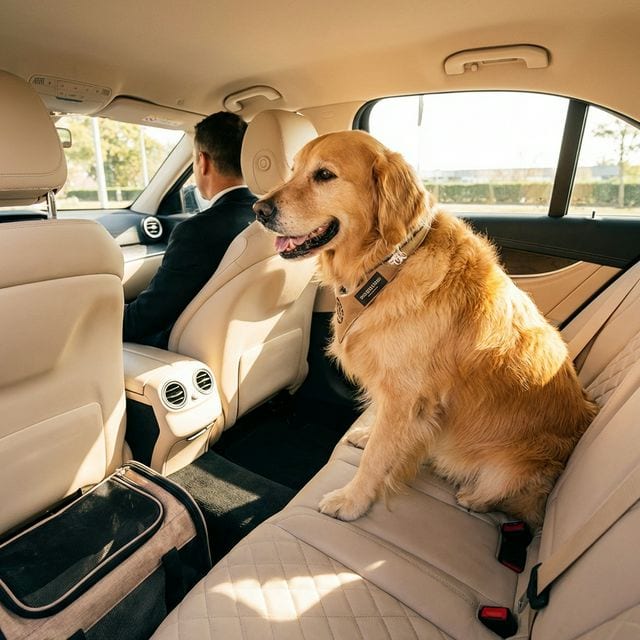
Golden retriever traveling comfortably in a private transfer vehicle with pet carrier
Turkey welcomes travelers with pets, but nobody tells you the practical part: what happens in the thirty minutes between walking out of Antalya Airport arrivals with a carrier in your hand and actually reaching your villa, hotel, or rental apartment. Regular taxis routinely refuse animals. Shared shuttle buses prohibit them outright in their terms of carriage. Public transport bans them except for very small carried pets. That leaves exactly one realistic, comfortable option for a family traveling with a dog or cat: a pre-booked private transfer where the driver already knows a pet is coming, the vehicle is sized correctly, and nobody is surprised or unhappy about a wagging tail in the back seat.
This guide is the long version — the one that actually answers the questions you have at 2am before a 6am flight. It covers the entry paperwork Turkey expects for dogs and cats, what happens at the airport when you land with an animal, why the transfer leg is the part most guides skip and the part that actually goes wrong most often, how to choose the right vehicle size, pet-friendly hotels and pensions along the Antalya coast, where to find a vet if something goes sideways, which beaches and parks welcome dogs, how to handle Turkey's large population of street cats and dogs respectfully, and what you need to do to fly home again. Where rules genuinely vary by country of origin, airline, or change from year to year, we say so directly rather than inventing a number that might be wrong by the time you read this.
---
Why a Private Transfer Is Effectively the Only Option With a Pet
Before the paperwork, it is worth being blunt about the logistics, because this is the part that catches first-time pet travelers off guard.
Taxis. Turkish taxi drivers are independent operators, and a meaningful share of them will refuse a dog outright, particularly a larger breed, regardless of how well-behaved the animal is. Those who do accept a pet often charge an improvised premium on the spot, with no guarantee the next driver in the rank will do the same. There is no consistent booking mechanism that lets you specify "traveling with a medium dog" before a taxi is dispatched.
Airport shuttle buses. Shared shuttle operators that serve Antalya (AYT), Dalaman (DLM), Gazipasa (GZP), and other Turkish airports carry animals in their terms of carriage as a blanket exclusion, with rare exceptions for very small pets fully enclosed in a soft carrier stowed under a seat — and even that is inconsistent between operators and not guaranteed at the gate. Shuttles also make multiple hotel stops, meaning a nervous animal spends longer in transit and is exposed to more strangers boarding and leaving.
Public buses, dolmuş minibuses, and trams. Officially restrictive on animals beyond a small pet carried in an enclosed bag, and in practice most drivers will simply wave a passenger with a dog off the vehicle rather than deal with the ambiguity.
Private transfer. This is the format built for exactly this situation. When you book a private vehicle and tell the operator in advance that you are traveling with a pet, the driver arrives already briefed: the right vehicle size, seat protection in place, water on board if the journey is long, and — critically — no other passengers to negotiate with, no stops at strangers' hotels, and a direct route from the airport to your door. It is also, in practical terms, no more complicated to book than a normal transfer: you simply add a note about your pet's type and approximate size when you reserve.
---
Bringing Your Dog or Cat Into Turkey: Entry Requirements
Turkey's pet entry rules are broadly aligned with the EU non-commercial pet travel framework, but they are not identical, and — importantly — the exact requirements depend on which country you are traveling from. What follows is the general shape of the rules as they typically apply. Because entry requirements for any country can change, always confirm current requirements with the Turkish consulate or embassy in your home country, or with your airline, no more than a few weeks before travel — do not rely solely on any single guide, including this one, for a document checklist you plan to travel on.
Core requirements that apply to both dogs and cats
Microchip. Your pet needs an ISO 11784/11785-compliant microchip, implanted before or at the same time as the rabies vaccination. If your pet was chipped with an older, non-ISO-compliant chip, you may need to travel with your own compatible scanner, since a chip that cannot be read is, for practical purposes, treated as if the pet is not chipped at all.
Rabies vaccination. Your pet must have a valid rabies vaccination administered by a licensed veterinarian. The standard rule mirrored across most pet-travel frameworks — and the one you should plan around — is that the vaccination must be at least 21 days old before travel (the immunity needs time to develop) and must still be within its manufacturer-stated validity period at the time of travel. A puppy or kitten vaccinated too close to your travel date will not meet the requirement, so vaccinate well ahead of a planned trip, not in the final week before flying.
Health certificate or pet passport. Travelers from EU countries can generally use the standard EU Pet Passport, which documents the microchip number, rabies vaccination, and any other required treatments in one official booklet. Travelers from non-EU countries typically need a veterinary health certificate issued by an official or government-accredited vet, usually within 10 days of travel, sometimes requiring an additional government endorsement (in the UK, for example, this has historically involved an Animal and Plant Health Agency-endorsed export health certificate). The exact certificate format and validity window depends on your country of departure — check with your national authority.
Titer (antibody) test. For pets arriving from countries not on Turkey's list of rabies-controlled or low-risk countries, a rabies antibody titer test is typically required, taken at least 30 days after the rabies vaccination and at least 3 months before travel, showing a sufficient antibody level. Pets traveling from most EU countries and a number of other recognized low-risk countries are generally exempt from this requirement, but this exemption list can change, so confirm your specific country's status before you fly rather than assuming.
Internal and external parasite treatment. Some routes and some airlines request evidence of a recent tapeworm and flea/tick treatment, administered by a vet shortly before travel, even where Turkish entry rules themselves do not strictly mandate it for every origin country. Carrying documentation of a recent treatment is a low-cost way to avoid friction at check-in or customs.
Customs declaration on arrival. On landing in Turkey, pet owners typically need to declare the animal to customs and present the documentation described above. There is generally no fee for this declaration when documents are complete and in order, though processing can add extra time to your arrival, which is worth factoring into any tight onward connection or a transfer booking with a narrow pickup window.
Quarantine
With complete, valid documentation, dogs and cats entering Turkey from most origin countries are not subject to mandatory quarantine. Quarantine (or refusal of entry) becomes a real risk specifically when documentation is missing, incomplete, or the rabies vaccination timing does not meet the minimum interval — which is exactly why the paperwork above deserves attention well before your flight, not the night before.
Breed considerations
Some countries maintain restricted or banned breed lists for import, commonly including breeds such as Pit Bull Terrier, American Staffordshire Terrier types, Dogo Argentino, Fila Brasileiro, and Japanese Tosa, among others depending on the specific list in force. If you are traveling with a large or commonly-restricted breed, verify current status directly with Turkish customs or your airline before booking, since restricted-breed policy is one of the areas most likely to change and least safe to assume about.
Documents checklist
| Document | Who needs it | Typical timing |
|---|---|---|
| ISO 11784/11785 microchip | All dogs and cats | Implanted before rabies vaccination |
| Rabies vaccination certificate | All dogs and cats | At least 21 days before travel, within validity period |
| EU Pet Passport (EU travelers) or official health certificate (non-EU travelers) | All dogs and cats | Health certificate typically issued within ~10 days of travel |
| Rabies antibody titer test | Pets from non-exempt / higher-risk countries only | At least 30 days after vaccination, at least 3 months before travel |
| Parasite treatment record (tapeworm, flea/tick) | Recommended for most routes; sometimes airline-required | Shortly before travel |
| Customs declaration | All pet owners, on arrival | Completed at the airport on landing |
Airline rules: cabin versus cargo
Airline pet policy sits on top of — not instead of — Turkey's entry requirements, and it varies significantly by carrier. As a general pattern across most airlines serving Turkey (including Turkish Airlines, Pegasus, SunExpress, and the major EU carriers), small pets under a combined pet-plus-carrier weight limit (commonly in the region of 6-8 kg, though this varies by airline) can usually travel in the cabin in an approved soft carrier stowed under the seat in front of you, for an additional fee. Larger dogs typically travel as manifested cargo or checked excess baggage in a pressurized, temperature-controlled hold, in an IATA-compliant hard-sided crate that meets specific size requirements relative to the animal. Many airlines also impose seasonal or breed-specific embargoes on hold travel — brachycephalic (flat-faced) breeds such as Bulldogs, Pugs, and Persian cats are frequently restricted or banned from cargo travel entirely due to respiratory risk, and summer heat embargoes on cargo pet travel are common on Turkish routes during the hottest months. Because every airline's weight limits, carrier specifications, fees, and seasonal restrictions differ, confirm the exact policy directly with your airline when booking your flight, not from a general guide.
Which Turkish airports handle pet arrivals
Antalya Airport (AYT) — the main gateway for the Turkish Riviera — routinely processes pet arrivals and has customs staff equipped to handle animal declarations, along with green areas immediately outside the arrivals terminal suitable for a short walk before the drive to your accommodation. Dalaman (DLM), Gazipasa-Alanya (GZP), and Istanbul's two international airports similarly handle pet arrivals as a matter of routine. If your itinerary is unusual — a small regional airport, an unusual routing, or a very early or very late flight — it is worth confirming with your airline or the airport that pet customs processing is available at that specific arrival time, since staffing for less common procedures can be reduced outside normal hours.
---
At the Airport: What Actually Happens When You Land With a Pet
For pets traveling in the cabin, you disembark with your pet's carrier as part of your hand luggage. For pets traveling in the hold, they are typically brought to a designated oversized/live-animal collection point near baggage claim, separate from the standard carousel — ask ground staff on arrival if you cannot immediately locate it, since signage for this varies between airports and terminals.
From there, expect this general sequence: passport control as normal for you; collection of your pet (from the cabin overhead/underseat carrier, or from the oversized baggage point); a customs declaration desk where you present the microchip, rabies vaccination, and health certificate or pet passport; and, if applicable, a brief visual check of the animal. With complete documentation this process is usually efficient, but build in extra time regardless — an unpredictable customs queue is a poor thing to discover for the first time while your pre-booked transfer driver is waiting outside.
Once you clear customs, most animals — especially dogs after a long flight — benefit from a short walk before getting into a vehicle. Antalya Airport has grass areas outside the arrivals hall suitable for this. Letting your dog relieve itself and stretch its legs for five to ten minutes before the transfer noticeably reduces stress for the rest of the journey, particularly if your onward drive is 60-90 minutes or longer.
---
The Transfer Itself: Getting From the Airport to Your Accommodation
This is the part general "pets in Turkey" guides tend to skip entirely, and it is where trips with animals most often go wrong — not because the country is unwelcoming, but because travelers assume any taxi or shuttle will simply work it out on the spot. It usually does not.
Planning your trip?
Enter your exact route and vehicle type to see the current booking price before confirmation.
Book in advance, and say so clearly
Tell us your pet's species, breed or type, and approximate size or weight when you book your private transfer — not as an afterthought at pickup, but at the time of booking. This lets us assign a vehicle that actually fits the animal comfortably, brief the driver, and prepare seat protection in advance rather than improvising at the curb while you and a jet-lagged dog wait.
Bring your own carrier or crate
For cats, a secure, well-ventilated carrier is not optional — cats that are frightened by a new environment and an unfamiliar vehicle can attempt to bolt the moment a door opens, and a loose cat inside a moving car is a genuine safety hazard for everyone in the vehicle. For small and medium dogs, a carrier or crate is strongly recommended, particularly for anxious or unfamiliar-environment-sensitive animals; a well-behaved, leash-trained larger dog can typically travel secured on the seat with a harness-and-seatbelt attachment instead, but bringing your own equipment gives you control over your pet's comfort rather than relying entirely on what the vehicle happens to have.
Vehicle size by pet size
| Pet size / type | Recommended vehicle | Notes |
|---|---|---|
| Cat (any size), small dog under ~10 kg | Standard sedan or Mercedes E-Class | Carrier fits comfortably on the seat or footwell, secured with a seatbelt strap where possible |
| Medium dog, 10-25 kg | Sedan or minivan, depending on carrier size | A large carrier for a medium dog often needs the extra floor space of a minivan |
| Large dog, 25-45 kg | Mercedes Vito-class minivan | More cargo and floor space for a crate or a dog lying down comfortably |
| Very large dog (45kg+) or multiple pets | Minivan with cleared cargo area | Crate secured in the rear cargo area; extra loading time should be planned into pickup |
Seat protection and cleaning
Seat covers are provided at no extra charge for any transfer booked with a pet in advance. The vehicle is professionally cleaned after every pet transfer — this is our responsibility, not something you need to arrange or pay extra for, and it is precisely why advance notice matters: a driver who knows a pet is coming has already prepared the vehicle before you ever get in.
Feeding, water, and timing
Feed your pet at least three hours before the transfer where possible, not immediately beforehand — a full stomach combined with a new vehicle and unfamiliar motion is the most common recipe for car sickness in pets that don't normally travel by car. Bring your pet's own water and a travel bowl; we also carry water for longer transfers as standard, but a familiar bowl and water from home reduces the chance of a nervous animal simply refusing to drink from something new.
Long routes and rest breaks
Most transfers from Antalya Airport to central resort areas like Lara, Kundu, and Konyaaltı run 20-45 minutes — short enough that a rest stop is rarely needed. Longer routes are a different story: Belek and Side run roughly 45-70 minutes, Alanya around 1.5-2 hours, and destinations further along the coast such as Kaş and Kalkan can run 2.5-3 hours or more. For any transfer beyond about 90 minutes, we build in a short rest stop if you request one — a chance for your dog to walk, drink, and decompress before continuing. Mention this preference when you book so the driver plans the stop into the route rather than deciding on the fly.
Heat safety in the Turkish summer
Turkish Riviera summers regularly reach 35-40°C (95-104°F) between June and September, and heat is the single biggest safety risk for a pet during any ground transfer in that season. All of our transfer vehicles run climate-controlled air conditioning, which should run continuously from pickup to drop-off — ask the driver to keep it running even during brief stops, since a parked vehicle with the engine off heats up within minutes in Turkish summer conditions, fast enough to become dangerous for an animal left inside even briefly. Never leave a pet alone in a parked vehicle in Turkey between May and October, regardless of how short the stop is expected to be — this applies whether you are the one stepping away or waiting for a driver, and it is worth being direct about because heatstroke in a parked car is fast, largely irreversible once symptoms set in, and entirely preventable simply by not doing it.
After the transfer
Vehicle clean-up after a pet transfer is handled on our side at no extra charge — you are not expected to clean fur, dirt, or anything else from the seats before you leave the vehicle. If the drive was long or your pet was anxious, give them a few minutes to settle at your destination before diving into unpacking; a short walk around the new property, water, and a familiar blanket or toy from the carrier go a long way toward turning a stressful arrival into a calm one.
Booking note: free child seats too
If your trip involves both a pet and young children, we provide free child seats on any booking on request — mention both when you reserve, since the vehicle assignment needs to account for a car seat, a pet carrier, and luggage all fitting comfortably together, which sometimes pushes the right choice from a sedan to a minivan even for a small family.
Pricing for pet-inclusive transfers is available on request when you book — tell us your pet's size and your route and we will confirm the right vehicle and price before you travel, so there are no surprises at pickup.
---
Pet-Friendly Accommodation on the Antalya Coast
Not every hotel in Turkey welcomes animals, and policies vary enormously even within the same resort town, so this section is about what to check rather than a guarantee any specific property will say yes.
What to ask before you book
- Is the policy per-stay or per-night, and is there a pet deposit or cleaning fee? Many properties that do accept pets still charge an additional nightly or one-time fee.
- Are there size or breed restrictions? Some pet-friendly hotels cap weight (commonly around 10-15 kg) or exclude specific breeds, even while advertising as "pet-friendly" generally.
- Is the pet allowed in all areas, or only the room and certain outdoor spaces? Pool decks, restaurants, and beach areas in Turkey are very commonly off-limits to pets even at otherwise pet-friendly hotels, for hygiene regulation reasons that apply broadly across Turkish tourism accommodation.
- Is there a maximum number of pets per room?
- What happens if you need to leave the pet in the room? Ask about any pet-sitting service or whether housekeeping needs advance notice to enter a room with an animal present.
Region-by-region character
Kaş and Kalkan on the Lycian coast tend to have the highest concentration of genuinely pet-welcoming boutique pensions and small hotels, reflecting a more relaxed, less resort-industrial character than the big all-inclusive belt further east. Many properties here are family-run and happy to discuss your pet's needs directly rather than pointing to a rigid printed policy.
Olympos and Çıralı — with their treehouse-style lodges and eco-tourism character — are similarly relaxed about pets in general, and the natural, uncrowded beach setting here is often more comfortable for a dog than a busy resort beach further along the coast.
Kemer has a reasonable number of 4-star hotels with pet-accepting policies, though beach access directly with a pet is more limited than in Kaş or Çıralı, and Kemer's pebble beaches get genuinely hot underfoot in peak summer — worth factoring in for a dog walking barefoot.
Lara and Kundu, Belek, and Side are dominated by large all-inclusive resorts, and pet policy here is inconsistent and frequently restrictive: many of the biggest 5-star complexes in Belek and Lara simply do not accept pets at all, given the scale of their food-and-beverage and pool operations and the hygiene regulations that come with that. If you specifically want an all-inclusive resort holiday with a pet, confirm directly with the property well in advance rather than assuming — do not book on the strength of a third-party listing alone.
Side sits in between: some smaller pensions on the town fringes accept pets even though the resort core generally does not.
---
Vets and Pet Pharmacies Along the Coast
Antalya, Kemer, Side, Belek, and Alanya all have private veterinary clinics used to treating tourists' pets, and most are accustomed to international paperwork such as EU pet passports. If your pet needs a health certificate for the return journey home, book that appointment well ahead of your departure date rather than in the final 48 hours — certificate validity windows are tight (commonly around 10 days for many destination countries) and a fully booked clinic on short notice is a real risk in peak season.
Pet pharmacies (often combined with a vet clinic or a dedicated "veteriner eczanesi") stock standard flea, tick, and worming treatments, as well as basic first-aid supplies, and are generally easy to find in any town with a significant expat or tourist population. If your pet is on a specific prescription medication at home, bring enough for the full trip plus a margin — do not assume an exact equivalent will be available locally, and if it is, expect brand names to differ from what you are used to.
If your pet has an emergency, ask your hotel or transfer driver for the nearest 24-hour veterinary clinic — larger towns like Antalya city and Alanya generally have one, while smaller coastal towns often do not, meaning a nighttime emergency in a small town may require a drive to a larger center.
---
Dog-Friendly Beaches and Parks
Turkey's public beaches are, in general, not officially dog-friendly, and many are managed under Blue Flag hygiene standards that formally exclude animals. That said, the picture varies significantly by location:
- Natural, less-developed beaches away from the main resort strips — parts of the coastline near Olympos and Çıralı, and stretches near Kaş — are generally more relaxed in practice, particularly outside of peak midday hours, though this is a matter of informal local tolerance rather than an official designation, and you should always be prepared to leash and remove your dog if asked.
- Resort beaches attached to hotels (Lara, Belek, Konyaaltı's managed sections) are the most strict, and pets are essentially never permitted on these, regardless of your hotel's own pet policy for rooms.
- Antalya city's Karaalioğlu Park and the Düden Waterfalls park areas are popular local green spaces where leashed dogs are commonly seen, making them a reasonable option for a walk rather than a beach day.
- Always carry water and waste bags. Even where dogs are informally tolerated, cleaning up after your pet is expected, and it goes a long way toward keeping these informal arrangements welcoming for the next visitor.
If a specific beach day with your dog matters to your trip, it is worth asking your hotel directly which nearby beach, if any, is realistically dog-tolerant that season, since informal local practice shifts year to year and is not something any single guide can guarantee.
---
Turkey's Street Animals: Culture, Safety, and Etiquette
Turkey has a large population of community-cared-for street cats and dogs, particularly in cities and coastal towns, and this is worth understanding before you travel, both for your own comfort and your own pet's safety.
These animals are generally not strays in the Western sense. Many are neutered, vaccinated, and ear-tagged as part of municipal trap-neuter-vaccinate-release programs, and are collectively cared for by neighborhoods, shopkeepers, and municipal feeding stations. Killing street animals for tourism purposes or aggressive removal is broadly not the norm in Turkish coastal cities, and community cats and dogs are a visible, generally tolerated part of daily life.
Do not feed street animals from your hotel plate or leftovers, however well-meaning — inconsistent, unfamiliar food can cause digestive problems, and feeding animals near restaurant terraces or pool areas is often specifically discouraged by hotel management for hygiene and pest-control reasons.
Keep some distance if you're traveling with your own pet. A friendly street dog approaching your leashed pet is common and usually harmless, but any unfamiliar-animal interaction carries some risk of a scuffle, so keep your own pet close and leashed in areas with visible street dog activity, and avoid approaching street cats with kittens, who can be defensively aggressive.
Rabies risk from street animals in tourist areas is low but not zero. Vaccination and neutering programs have substantially reduced rabies incidence in Turkey's major coastal tourist zones over the past decade, but it is not eliminated nationally, particularly in rural or less-managed areas. Avoid direct contact with any street animal that appears sick, aggressive, or is behaving unusually, and if you or your pet is bitten or scratched by an unfamiliar animal anywhere in Turkey, seek medical or veterinary attention promptly rather than waiting to see if symptoms develop.
---
Planning your trip?
Enter your exact route and vehicle type to see the current booking price before confirmation.
Flying Home: Return Paperwork
Getting your pet home involves its own document trail, largely separate from what got them into Turkey, and it depends entirely on your destination country's rules rather than Turkey's.
Returning to the EU. If your pet has an EU Pet Passport, most of the outbound requirements (microchip, valid rabies vaccination) remain valid for the return leg as long as the rabies vaccination has not expired. If your pet's passport has expired or the vaccination needs renewal, arrange this with a vet in Turkey well before departure — see the vets section above.
Returning to the UK. The UK requires an animal health certificate for pets returning from outside the pet travel scheme's simplified pathway, generally issued within 10 days of travel by an authorized vet, along with the standard microchip and rabies vaccination requirements, and — depending on current UK policy at time of travel — potentially a tapeworm treatment administered by a vet within a specific window before arrival. UK pet travel rules have changed more than once in recent years, so confirm current requirements directly with UK government guidance close to your travel date rather than assuming last year's rules still apply.
Returning to the US, Canada, Australia, and other non-EU countries. Requirements vary substantially and are generally stricter than the EU framework, particularly for Australia, which maintains extensive quarantine and pre-clearance requirements for dogs and cats from most countries. If you are returning to a country outside the EU/UK, start researching your destination's specific pet import requirements as early as possible in your trip planning — ideally before you even book your flights to Turkey — since some countries require blood tests, permits, or paperwork initiated months in advance.
General advice regardless of destination. Book your return health certificate appointment with a Turkish vet as early in your trip as the certificate's validity window allows, keep every document from your outbound journey (you may need to show continuity of vaccination history), and confirm your airline's outbound pet policy applies identically to the return leg — cargo embargoes, seasonal heat restrictions, and carrier requirements typically apply in both directions.
---
Booking Your Pet-Friendly Airport Transfer
When you book your private transfer with us, here is what to include so we get it right the first time:
1. Pet type and approximate size or weight — this determines vehicle assignment (sedan versus minivan). 2. Whether you're bringing your own carrier/crate, and roughly what size it is, if you have one. 3. Route and expected journey length — so we can plan a rest stop in advance for longer routes like Alanya or the Lycian coast. 4. Any other passengers or luggage, including whether you also need a free child seat, so the vehicle can comfortably fit everyone and everything. 5. Flight number and arrival time, as with any transfer, so your driver is tracking your flight and waiting when you clear customs with your pet.
Pricing for pet-inclusive transfers is available on request — tell us your pet's details and route when you book, and we'll confirm the right vehicle and price before you travel. There's no penalty for asking; the only mistake is not mentioning your pet at all and hoping the vehicle that turns up happens to work.
Related reading: our guide to group and family minibus transfers if you're traveling as a larger family group with pets and children together, our comparison of airport taxis versus private transfers if you want the fuller case for booking ahead, and our guide to traveling with children and child seats if your trip combines both kids and pets.
---
Frequently Asked Questions
Do Turkish taxis accept pets?
Inconsistently, and you should not rely on it. Many taxi drivers will refuse a dog outright, especially larger breeds, and those who accept a pet often charge an improvised extra fee on the spot with no advance guarantee. A pre-booked private transfer, where the driver knows in advance that a pet is traveling, is the reliable option.
Can I bring my dog on an airport shuttle bus in Turkey?
Generally no. Shared shuttle operators serving Turkish airports typically exclude animals from their standard terms of carriage, with rare and inconsistent exceptions for a very small pet fully enclosed in a soft carrier. Do not plan around a shuttle accepting your pet without confirming directly with that specific operator first.
Does my dog need to be quarantined when entering Turkey?
Not if your documentation is complete and valid — microchip, rabies vaccination administered at least 21 days before travel, and the correct health certificate or EU Pet Passport. Quarantine or entry refusal becomes a real risk specifically when paperwork is missing or the vaccination timing doesn't meet the minimum interval, so prepare documents well ahead of travel rather than at the last minute.
Is a rabies titer test always required to bring my pet to Turkey?
No — pets arriving from most EU countries and a number of other recognized low-risk countries are generally exempt. Pets from countries not on that list typically do need a titer test, taken at least 30 days after vaccination and at least 3 months before travel. Since the exempt-country list can change, confirm your specific country's current status before booking non-refundable travel.
Can my cat travel in the cabin with me on the flight to Turkey?
Usually yes, subject to your specific airline's weight and carrier-size limits — commonly a combined pet-plus-carrier weight around 6-8 kg, though this varies by airline, along with an additional fee. Confirm exact limits directly with your airline when booking, since policies differ and change.
What vehicle do I need for a large dog transfer from the airport?
For dogs in the roughly 25-45 kg range, a Mercedes Vito-class minivan is recommended, since it provides enough floor and cargo space for a crate or a dog to lie down comfortably. Sedans generally suit cats and smaller dogs. Tell us your pet's size when booking and we'll assign the right vehicle.
Do I need to bring my own pet carrier for the transfer?
For cats, yes — a secure carrier is essential, since a loose cat in a moving vehicle is a genuine safety issue. For dogs, a carrier or crate is strongly recommended, particularly for anxious animals, though a calm, leash-trained larger dog can often travel secured with a harness and seatbelt attachment instead.
Is there an extra charge for traveling with a pet?
Pricing for pet-inclusive transfers is available on request based on your pet's size, the vehicle required, and your route — tell us the details when you book and we'll confirm the price in advance so there are no surprises.
How hot does it get in a parked car in Turkey, and is that dangerous for my pet?
Turkish Riviera summers regularly reach 35-40°C, and a parked vehicle with the engine and air conditioning off heats up within minutes, fast enough to become dangerous for an animal left inside even briefly. Never leave a pet alone in a parked car in Turkey between May and October, and ask your driver to keep the air conditioning running during any stop.
Which areas near Antalya are most pet-friendly for accommodation?
Kaş, Kalkan, Olympos, and Çıralı generally have the highest concentration of genuinely pet-welcoming boutique pensions and small hotels. Large all-inclusive resort belts like Belek, Lara, and Kundu are far more restrictive, and many big resorts do not accept pets at all — always confirm directly with the specific property before booking.
Are Turkey's street cats and dogs dangerous to my pet or to me?
Generally not — most are neutered, vaccinated, and cared for through municipal and community programs, and coexist peacefully with residents and tourists. Keep some distance if your own pet is nervous around unfamiliar animals, don't feed street animals from your plate, and avoid any animal showing signs of illness or aggression.
What documents do I need to fly my pet home from Turkey?
This depends entirely on your destination country. EU-bound pets generally need a valid rabies vaccination and pet passport. UK-bound pets typically need an animal health certificate issued within about 10 days of travel, plus possibly a tapeworm treatment. Other destinations, especially Australia, have significantly stricter requirements. Book your return health certificate with a Turkish vet early in your trip and confirm your destination country's current rules directly with their official guidance.
---
Regulations for pet travel change periodically and can vary by country of origin, airline, and time of year. This guide reflects the general framework as it typically applies, but always confirm current, country-specific requirements with your airline and the relevant government authority close to your travel date before finalizing any pet travel plans.
Planning your trip?
Enter your exact route and vehicle type to see the current booking price before confirmation.