Turkish Coffee Culture Guide 2026: History, How to Drink It, Fortune Telling and the Best Cafes

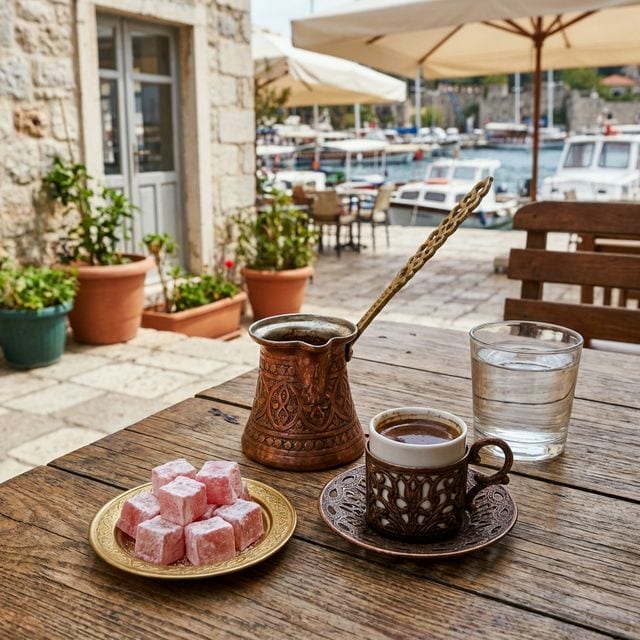
Traditional Turkish coffee in ornate cup with cezve, Turkish delight, and harbor cafe backdrop
Turkish coffee is not simply a drink. It is a 500-year-old ritual, a UNESCO Intangible Cultural Heritage element, a language of hospitality, and — for millions of Turks — the closest thing the culture has to a fortune-telling tradition that everyone, from grandmothers to teenagers, still practices without irony. A single small cup of Turkish coffee carries more ceremony than most Western drinks manage in an entire meal: the grind has to be powder-fine, the brewing has to be slow and watched, the foam has to survive the pour, the sugar has to be chosen before a single drop touches the pot, and when the cup is empty, the story is not over — it is just getting started, because now someone is going to flip it over and read your future in the grounds.
This guide is the deepest resource online in 2026 for understanding Turkish coffee as it is actually lived in Turkey today: the Ottoman history that turned a Yemeni import into a national identity, the precise mechanics of brewing it in a cezve, the sugar-level vocabulary you need to order it correctly, the etiquette of drinking it without embarrassing yourself, the full ritual of kahve falı (coffee fortune telling) with its dozens of recurring symbols, the regional variants most tourists never hear about, and where in Antalya and Istanbul to drink the best cup. Whether you are planning a private transfer from Antalya Airport into the old town of Kaleiçi to start your own coffee trail, or you simply want to understand what is happening in the fincan in front of you, this is the complete picture.
A Short History of Turkish Coffee: From Yemen to a UNESCO Heritage
Coffee itself did not originate in Anatolia. The plant's story begins in the highlands of Ethiopia, where legend credits a goatherd named Kaldi with noticing his goats became unusually energetic after eating the red berries of a certain shrub. From Ethiopia, coffee cultivation and drinking crossed the Red Sea into Yemen by the 15th century, where Sufi monks began brewing it to stay awake through long nights of prayer and meditation. Yemen, and specifically the port city of Mocha, became the epicenter of the early coffee trade, and it is from Yemen that coffee made its way north into the Ottoman Empire.
The commonly cited date for coffee's arrival in Istanbul is 1555, when two traders — Hakam from Aleppo and Şems from Damascus — opened what are generally regarded as the first coffeehouses in the Ottoman capital, then called Kahvehane. The drink spread through the empire with astonishing speed. Within a few decades, coffeehouses had become fixtures of urban life across Istanbul, Bursa, Edirne, and eventually the wider empire, including the Mediterranean coast where Antalya sits today. These early coffeehouses were not simply places to drink; they became the social and intellectual nerve centers of Ottoman cities — spaces where merchants closed deals, poets recited verse, storytellers performed, chess and backgammon were played for hours, and political discussion (sometimes to the alarm of the authorities) took place openly among men of every class.
That last point is historically significant. Ottoman coffeehouses were among the very few public spaces in the empire where a porter and a pasha might, in theory, sit in adjoining seats. This social leveling worried the state at various points. Coffee and coffeehouses were banned outright more than once in Ottoman history — most famously under Sultan Murad IV in the 17th century, who treated coffeehouse gatherings as potential breeding grounds for sedition and enforced the ban with punishments as severe as execution for repeat offenders. The prohibition did not stick. Coffee was simply too embedded in daily life, too central to hospitality customs, and too profitable to suppress permanently, and within a generation the coffeehouses were back, busier than before.
By the 17th and 18th centuries, Ottoman coffee culture had exported itself outward through diplomacy, trade, and war. The failed Ottoman siege of Vienna in 1683 is the source of one of the most repeated (and only partially verified) origin stories in coffee history: that abandoned sacks of coffee beans left behind by the retreating Ottoman army became the seed of Vienna's famous coffeehouse culture, and by extension much of European café society. Whatever the precise truth of that story, it captures something real — Ottoman coffee culture was the conduit through which coffee drinking spread into Central and Western Europe, carrying with it not just the beans but rituals of hospitality, conversation, and leisurely socializing around a small cup.
Within Ottoman domestic life, coffee took on a role far beyond refreshment. It became embedded in marriage customs (a bride's ability to make good coffee was — and in some families still is — considered evidence of her domestic skill, and the tradition of serving salty coffee to a prospective groom as a good-natured test of his character survives today), in mourning customs (bitter, unsweetened coffee served at funerals and memorial gatherings), and in daily hospitality (no guest leaves a traditional Turkish home without being offered coffee or tea). The phrase "a single cup of coffee has forty years of memory" (bir fincan kahvenin kırk yıl hatırı vardır) is one of the most quoted proverbs in Turkish, and it is not decorative language — it describes an actual social obligation. Sharing a cup of coffee with someone is understood to create a bond of goodwill that Turkish culture expects both people to honor for a very long time.
In 2013, UNESCO formally recognized "Turkish coffee culture and tradition" by inscribing it on the Representative List of the Intangible Cultural Heritage of Humanity. The listing specifically credits the entire social apparatus around the drink — not merely the brewing method, but the customs of hospitality, the fortune-telling ritual, the role of coffee in courtship and marriage negotiations, and the social function of the coffeehouse — as a living tradition worth protecting and transmitting to future generations. This UNESCO status is frequently mentioned by Turkish cafe owners and tour guides today, and for good reason: it is a rare case of a beverage tradition receiving the same category of international recognition normally reserved for festivals, crafts, and performing arts.
What Actually Makes Turkish Coffee Different
| Feature | Turkish Coffee | Espresso | Filter/Drip Coffee |
|---|---|---|---|
| Grind | Ultra-fine, almost powder | Fine | Medium-coarse |
| Brewing method | Slowly heated and boiled in a cezve | Forced through grounds under pressure | Water drips or pours through grounds |
| Filtration | None — grounds stay in the cup | Filtered by the puck | Filtered by paper or mesh |
| Sugar | Chosen and added BEFORE brewing | Added after, if at all | Added after, if at all |
| Foam (köpük) | Essential — a good cup has a thick foam cap | Crema, thinner and different in character | None |
| Strength/body | Very strong, dense mouthfeel | Strong, concentrated | Variable, generally lighter |
| Serving vessel | Small porcelain fincan (60-80ml) | Demitasse cup | Large mug or cup |
| Standard accompaniment | A glass of water, often Turkish delight | Nothing standard | Nothing standard |
| Fortune telling | Yes — an entire tradition (fal) | No | No |
| Brewing time | 4-6 minutes of close attention | 20-30 seconds | 3-5 minutes, largely unattended |
How Turkish Coffee Is Made: Equipment, Grind, and Technique
The Cezve
The single piece of equipment that defines Turkish coffee brewing is the cezve (pronounced roughly "jez-veh," and known in some regions and export markets as an ibrik). It is a small pot, traditionally made of copper (sometimes tinned on the inside to prevent the coffee from reacting with bare copper) or brass, though stainless steel versions are common today for practicality and hygiene. The shape is distinctive and functional: a narrow neck that flares out to a wider base, which increases the surface area in contact with heat while concentrating the foam near the narrow opening as the coffee rises. A long handle keeps your hand away from the heat source, which matters because you will be holding the cezve, watching it closely, for several uninterrupted minutes.
Cezves come in sizes corresponding to the number of cups being made — typically single, double, or four-cup sizes — and using the correctly sized pot matters more than in most brewing methods, because the ratio of surface area to liquid volume affects how the foam develops.
The Grind
Turkish coffee requires the finest grind used in any mainstream brewing method in the world — finer than espresso, closer in texture to flour or powdered sugar than to any grind size Western coffee drinkers typically encounter. This fineness is essential for two reasons. First, since the coffee is never filtered, a coarser grind would leave gritty, unpleasant particles suspended through the entire cup rather than settling cleanly at the bottom. Second, the fine grind maximizes surface area, allowing full extraction during the very short brewing window of a few minutes, which is what gives Turkish coffee its characteristic intensity and body despite using relatively little heat and time compared to some other methods.
Achieving this grind at home requires a specific type of burr grinder capable of producing true Turkish-fine powder; a standard home espresso grinder usually cannot get fine enough. This is why most people — Turkish households included — buy pre-ground Turkish coffee rather than grinding their own, and it is also why the traditional hand-cranked brass grinders (used historically, and still sold as souvenirs) exist: their long grinding chamber and adjustable screw mechanism were specifically engineered to produce this ultra-fine texture by hand, long before electric grinders existed.
The Brewing Process, Step by Step
1. Measure the water and coffee. The standard ratio is roughly one heaped teaspoon of ultra-fine ground coffee per demitasse cup of cold water, though proportions vary by household and by how strong a cup is wanted. 2. Add sugar now, if any is wanted. This is the detail that surprises most visitors: sugar in Turkish coffee is added to the cezve before brewing, not stirred in afterward. Because the coffee is never stirred again once poured (stirring after pouring would disturb the foam), the sugar level has to be decided and mixed in at the very start. 3. Combine everything in the cezve and stir once. Cold water, the fine grounds, and sugar (if using) go into the cezve together and are stirred gently just enough to combine — then no further stirring happens for the rest of the process. 4. Heat slowly over low heat. This is the part that separates a good cup from a mediocre one. Turkish coffee must never be rushed to a boil; it needs low, gentle, patient heat so the grounds infuse gradually and a stable foam has time to form on the surface. Rushing the heat produces a thin, weak foam or none at all. 5. Watch for the foam to rise. As the coffee heats, a foam cap (köpük) begins to build on the surface. Just as it is about to boil over — a critical, easy-to-miss moment that takes practice to judge — the cezve is pulled off the heat. 6. Distribute the foam first. The foam is carefully spooned or poured evenly across the cups before the rest of the liquid is added, because foam does not divide itself evenly if you simply pour straight through. A cup without foam is considered a lower-quality pour, and in some households a coffee served without foam is quietly judged as a sign the host either rushed the brewing or does not know what they are doing. 7. Return to heat briefly (optional, traditional method). Some traditional techniques bring the coffee back to a very brief second and even third rise, building a thicker, more stable foam layer before the final pour — a technique that takes real practice to execute without letting the pot boil over. 8. Pour gently and let it rest. The coffee is poured into the small porcelain fincan and allowed to sit for a minute or two before drinking, giving the grounds time to begin settling toward the bottom of the cup.
Sand Coffee: The Theatrical Version
In tourist-heavy parts of Turkey — and Antalya's old town of Kaleiçi is a prime example — you will often see coffee brewed not on a stovetop flame but buried in a tray of hot sand (kum kahvesi, literally "sand coffee"). The cezve is nestled into fine, superheated sand that surrounds the pot evenly on all sides rather than concentrating heat on the base the way a burner does. This produces an extremely gentle, uniform heat that is genuinely well suited to developing a rich, stable foam, and it has become something of a signature spectacle in cafes that want to showcase the craft — baristas trained in sand coffee technique can control the heat with remarkable precision simply by moving the cezve to hotter or cooler zones within the sand tray. It is not purely theater; sand brewing is a legitimate, historically rooted technique, but its visual appeal has undeniably made it a popular feature in cafes aimed at both locals who appreciate the craftsmanship and visitors who want to watch the process.
Regional Variants Most Tourists Never Hear About
Standard Turkish coffee is only the most famous member of a wider family of regional coffee traditions across Turkey, several of which are well worth seeking out if you want to go beyond the tourist-menu version.
Planning your trip?
Enter your exact route and vehicle type to see the current booking price before confirmation.
Menengiç Kahvesi (Terebinth Coffee)
Popular in southeastern Turkey, particularly around Gaziantep and Mardin, menengiç kahvesi is not made from coffee beans at all — it is brewed from roasted terebinth (wild pistachio) berries, sometimes blended with actual coffee. The result is naturally caffeine-free or very low in caffeine, with a nutty, earthy flavor and a golden-brown color quite different from standard Turkish coffee's dark, opaque cup. It is traditionally served hot, often with milk, and is a good option for anyone avoiding or limiting caffeine who still wants an authentic Turkish coffeehouse experience.
Dibek Kahvesi
Dibek kahvesi is Turkish coffee ground in a traditional stone mortar (the dibek) rather than a modern grinder, using a hand-operated pestle process that produces a coarser, more textured grind than standard machine-ground Turkish coffee. The stone-grinding method is slower and more labor-intensive, and produces a noticeably different mouthfeel and aroma profile — many enthusiasts describe it as richer and more aromatic. It is often sold, and marketed, as a premium, artisanal version of standard Turkish coffee, and specialty coffee shops in tourist areas frequently stock it alongside the regular grind.
Mırra
Mırra is an especially bitter, unsweetened coffee tradition from southeastern Turkey, associated closely with Arab and Kurdish hospitality customs in the region. It is brewed without sugar under any circumstance — sweetening mırra would be considered a departure from the tradition entirely — and is traditionally served in small handleless cups, poured in careful small amounts as a gesture of respect and welcome to guests. Because mırra is intensely bitter and strong, it is typically served in smaller quantities than standard Turkish coffee, more as a ceremonial welcome gesture than an everyday drink.
Osmanlı Kahvesi (Ottoman-Style Coffee)
Some historically themed cafes, particularly in Istanbul and increasingly in Kaleiçi's Ottoman-house cafes in Antalya, serve "Ottoman coffee," typically flavored with spices such as mastic (sakız), cardamom, or cloves, echoing recipes and flavor additions that were more common in the palace and elite households of the Ottoman era than in everyday households. This is more a marketing and thematic framing than a strictly distinct historical brewing method, but the flavored versions are genuinely enjoyable and worth trying at least once.
Sugar Levels: How to Order Turkish Coffee Correctly
| Turkish Term | Literal Meaning | Sugar Amount | Who It's For |
|---|---|---|---|
| Sade | Plain | No sugar at all | Purists, and anyone who wants to taste the coffee's true bitterness |
| Az şekerli | Slightly sweet | About half a teaspoon | A gentle sweetness, popular middle-ground choice |
| Orta | Medium | About one teaspoon | The most commonly ordered level, and the standard recommendation for first-timers |
| Şekerli | Sweet | About two teaspoons | For those who find plain Turkish coffee too bitter |
| Çok şekerli | Very sweet | Two or more heaped teaspoons | Rarely ordered by adults; sometimes for children's diluted versions or those with a strong sweet tooth |
How to Drink Turkish Coffee Properly (Without Embarrassing Yourself)
There is genuine etiquette around drinking Turkish coffee, and following it signals respect for the tradition — locals notice, and appreciate, when a visitor drinks it the right way.
Drink the water first, not the coffee. Turkish coffee is almost always served with a small glass of plain water alongside it. The water is meant to be drunk before the coffee, not after, and its purpose is to cleanse and neutralize your palate so you taste the coffee's full flavor rather than whatever you ate or drank beforehand. Some people also sip a little water between sips of coffee, but drinking it entirely before starting the coffee is the traditional and most common approach.
Sip slowly — this is not a drink to gulp. Turkish coffee is meant to be savored over a genuine stretch of conversation, often ten to twenty minutes for a small 60-80ml cup. It is intentionally paced as a social ritual rather than a quick caffeine hit, and gulping it both wastes the experience and risks disturbing the settling grounds, which can send gritty sediment further up into the liquid you are still drinking.
Let the cup sit for a minute before your first sip. Freshly poured Turkish coffee is very hot, and the grounds need a short rest period to begin settling toward the bottom of the cup. Diving in immediately means drinking more grounds than necessary and risking a scalded tongue.
Stop before the bottom. As you approach the last quarter to third of the cup, the texture will noticeably change — you will feel and often see the thick, muddy sediment of spent grounds. This is the signal to stop drinking. The grounds themselves are not meant to be consumed; they are bitter, gritty, and unpleasant, and more importantly, they are the raw material for the fortune-telling ritual that typically follows.
Never stir the coffee once it's poured. Unlike Western coffee, where stirring in cream or sugar is normal and expected, stirring a Turkish coffee after it has been poured disturbs the foam cap and mixes the settled grounds back into the liquid you are drinking. If sugar was requested correctly at the brewing stage, there is nothing left to stir in.
Accept the accompanying sweet, if offered. Turkish coffee is very frequently served alongside a small piece of Turkish delight (lokum) or occasionally a small chocolate. Tradition holds that you eat the sweet first, then drink the coffee — the sugared treat is thought to complement and balance the intensity of the unsweetened or lightly sweetened coffee that follows. It is polite, though not obligatory, to accept it.
Compliment the host, especially if they made it themselves. Because good foam and a well-judged brew genuinely require practice, complimenting a host's coffee — particularly the foam — is a small but meaningful courtesy, similar to complimenting a home-cooked meal.
What Comes With Turkish Coffee
A proper serving of Turkish coffee is rarely just the cup itself. The traditional accompaniments are part of the ritual, not optional extras:
- A glass of water. As covered above, this is nearly universal and serves a genuine palate-cleansing function, not merely decoration.
- Turkish delight (lokum). A small cube or two of lokum, often rosewater, pistachio, or pomegranate flavored, is a very common pairing, particularly in cafes catering to visitors or in more formal hospitality settings.
- A small piece of chocolate. In some households and cafes, a single chocolate square is offered instead of or alongside lokum.
- A small plate or napkin. Presentation matters in Turkish hospitality; even a simple home-served coffee is typically brought out on a proper tray with a saucer, small spoon, and folded napkin, particularly when guests are present.
- Sometimes a small savory bite. In more elaborate or celebratory settings — engagement ceremonies especially — coffee may be accompanied by small pastries or savory snacks as part of a larger spread.
The Fortune-Telling Ritual: Kahve Falı, Step by Step
This is the part of Turkish coffee culture that surprises and delights visitors most, because it turns the end of a simple drink into an entirely separate social event. Kahve falı (coffee fortune telling) is not a fringe superstition practiced by a small mystical minority — it is a mainstream, widely enjoyed social ritual practiced across generations and social classes, treated by most participants somewhere between genuine belief and lighthearted entertainment, much the way many Western cultures treat astrology or tarot at a casual level.
Planning your trip?
Enter your exact route and vehicle type to see the current booking price before confirmation.
Step 1: Finish the coffee, but not all of it
As covered above, you drink until you reach the sediment, then stop. A small amount of liquid coffee typically remains at the very bottom along with the thick grounds.
Step 2: Make a wish or think of a question (optional but traditional)
Before flipping the cup, it is traditional to silently make a wish or hold a specific question in mind — the fortune reading that follows is sometimes framed as an answer to that unspoken question.
Step 3: Cover the cup with the saucer and flip it
The saucer is placed on top of the cup like a lid, and then the entire cup-and-saucer combination is flipped upside down in one motion, so the cup now rests inverted on top of the saucer. This allows the remaining liquid and grounds to spread down and across the interior walls of the cup as they settle, coating the surface where the patterns will form.
Step 4: Some traditions add a small ritual gesture
Depending on family or regional custom, the person may make a small cross or circular motion with the cup before setting it down, or press a coin, ring, or another small object briefly against the base of the cup — customs vary widely and are not universal, so do not worry if your host skips this step entirely.
Step 5: Wait for the cup to cool — usually 5 to 15 minutes
This waiting period allows the coffee residue to dry and set against the porcelain, forming the shapes and patterns that the fal reader will interpret. Rushing this step produces smeared, illegible patterns, so patience matters here as much as it does during the brewing itself.
Step 6: The reading (falcı okur)
Once cooled, the saucer and cup are separated and the reader examines the patterns left behind — on the interior of the cup, sometimes also on the saucer itself. A skilled or experienced falcı (fortune teller) — who might be a professional at a dedicated fal cafe, or simply an older relative or friend who has a reputation for being good at it — looks for recognizable shapes, symbols, and their positions (near the rim often relates to the near future; deeper toward the base can relate to more distant events or deeper concerns) and weaves them into a narrative about the drinker's life, relationships, and near future.
Step 7: The conversation
Unlike a written horoscope, kahve falı is inherently interactive and conversational. The person receiving the reading typically responds, asks questions, offers context ("actually, I have been thinking about a job change"), and the reading develops as a back-and-forth dialogue rather than a one-way pronouncement. This conversational, personalized quality is a large part of why the ritual remains so socially popular — it is as much an excuse for intimate conversation between friends as it is a genuine attempt at divination.
Common Fal Symbols and Their Meanings
| Symbol | Common Meaning |
|---|---|
| Bird | Good news is coming, often about travel or a message from someone far away |
| Tree | Growth, success, stability — a full, leafy tree is especially positive |
| Heart | Love, romance, or a deepening emotional relationship |
| Fish | Money, abundance, and prosperity arriving |
| Eye | Someone is watching over you — can mean protection, or a warning to be cautious of envy |
| Mountain | An obstacle or challenge that will require effort to overcome |
| Road or path | A journey ahead — literal travel, or a significant life change |
| Ring | An engagement, marriage, or a new commitment approaching |
| Snake | A warning — betrayal, a hidden enemy, or deception to watch for |
| Star | Wishes fulfilled, good fortune, and hope |
| Letter or envelope | News is coming, often written or delivered indirectly |
| Ladder | Career advancement or a rise in status |
| Cat | Someone deceptive or two-faced in your circle |
| Dog | A loyal friend, or steadfast support from someone close |
| Flower | Happiness, a pleasant surprise, or a joyful occasion approaching |
| Boat or ship | A journey, particularly one involving travel over water, or a fresh start |
| Clouds | Uncertainty or temporary difficulty, generally understood to pass |
| Human figure | Represents a specific person relevant to the drinker's question or life situation |
| Umbrella | Protection from a coming difficulty, or a need to guard against something |
| Key | A solution or opportunity that is about to reveal itself |
Etiquette Around Fal
A handful of unwritten rules govern the fortune-telling ritual, and understanding them will help you participate naturally:
- You don't ask for a fal reading for yourself in a hosting situation — it's typically offered, not requested, especially in someone's home. In a dedicated fal cafe, of course, requesting a reading is exactly the point, and entirely normal.
- Negative readings are usually softened. A good falcı, particularly among friends, tends to phrase difficult symbols gently ("there might be a small obstacle, but it looks temporary") rather than delivering bluntly ominous pronouncements — the ritual is meant to be enjoyable, not distressing.
- It is considered impolite to dismiss the reading outright, even if you are skeptical. Most Turks approach fal with a mixture of genuine curiosity and knowing playfulness, and treating it as pure superstition to be openly mocked can come across as dismissive of a cherished social tradition, even among people who do not seriously believe it.
- Reciprocity is common. If a friend reads your cup, it is natural and expected for the roles to reverse at some point — everyone gets a turn.
- Professional falcı readings, offered at dedicated fal cafes especially in Istanbul and in tourist-oriented cafes in places like Kaleiçi, are a paid service and function similarly to a psychic or tarot reading elsewhere — approached with the same blend of curiosity, entertainment, and occasional genuine belief that customers bring to those traditions worldwide.
Turkish Coffee vs. Turkish Tea: Understanding the Two Pillars of Turkish Hospitality
| Feature | Turkish Tea (Çay) | Turkish Coffee |
|---|---|---|
| Frequency of consumption | All day, every day — often six or more small glasses | Occasional — usually one or two cups, often after a meal |
| Social role | The default offering for any visitor, business meeting, or casual gathering | Reserved for special hospitality, guests, and specifically for fortune telling |
| Serving vessel | Small tulip-shaped glass (ince belli bardak) | Small porcelain cup (fincan) |
| Sweetening | Sugar cubes added and stirred in by the drinker, freely adjustable | Chosen and cooked in before brewing, fixed once poured |
| Social expectation | Declining an offered tea is considered mildly rude in most settings | Declining coffee is socially acceptable without offense |
| Preparation time | Brewed continuously throughout the day in a çaydanlık (double teapot) | Brewed fresh, per order, taking several attentive minutes |
| Everyday role | The genuine daily social glue of Turkish life | The ceremonial, occasional counterpart |
Where to Drink the Best Turkish Coffee in Antalya
Antalya's old town, Kaleiçi, is genuinely one of the best places in the entire country to experience Turkish coffee culture properly, because it combines a dense concentration of historic Ottoman-era stone houses (many converted into atmospheric cafes), harbor views, and a strong tourism infrastructure that keeps traditional brewing techniques — including sand coffee — visibly on display rather than hidden in a back kitchen.
Harbor-view cafes around the old marina. A cluster of cafes overlooking Kaleiçi's historic harbor combine sweeping Mediterranean views with traditional Turkish coffee service, and several offer fal readings on request, either from staff or from resident falcı who work specific evenings. This is a natural stop after a walk down through the old town toward the water, and one of the most photogenic settings anywhere in the city for a coffee break.
The Kaleiçi bazaar district cafes. The narrow stone streets around Kaleiçi's old bazaar area are dense with small, atmospheric cafes, many run out of restored Ottoman houses with courtyard seating, low cushioned benches, and genuinely old architectural details. These cafes lean into the traditional atmosphere heavily and are a strong choice for anyone who wants their coffee experience to feel connected to the historic setting, not just the drink itself.
Cafes near Hadrian's Gate. The area around this Roman-era monument at the entrance to Kaleiçi's old town has several Ottoman-style seating cafes that specialize in cezve-brewed coffee served in a more formal, traditional style, often with low seating and floor cushions reminiscent of historical Ottoman coffeehouse interiors.
Upper Kaleiçi castle terrace cafes. Higher up in the old town, several cafe terraces combine panoramic views over the city and coastline with a full traditional coffee ritual, and tend to be a favorite for visitors who want to combine sightseeing with a relaxed, unhurried coffee stop — exactly the pacing the ritual itself is designed for.
Local neighborhood kahvehane. Beyond the tourist-oriented cafes of Kaleiçi, ordinary neighborhood kahvehane exist throughout Antalya and across Turkey, historically associated with older men gathering to play backgammon, discuss the news, and drink coffee and tea for hours at a stretch. These are overwhelmingly informal, inexpensive, and — despite their traditional reputation as male social spaces — generally welcoming to curious visitors who want to see how ordinary Turks actually experience coffeehouse culture away from the tourist trail.
Istanbul, for context. While this guide is centered on Antalya, it is worth noting that Istanbul remains the historical and cultural capital of Turkish coffee, home to some of the country's oldest continuously operating coffee institutions and a dense concentration of dedicated fal cafes, particularly around neighborhoods with strong Ottoman-era architectural character. Many visitors who fall in love with Turkish coffee culture in Antalya go on to seek out Istanbul's coffee institutions on a separate trip.
Planning your trip?
Enter your exact route and vehicle type to see the current booking price before confirmation.
Buying Turkish Coffee and a Cezve to Take Home
Turkish coffee makes one of the most authentic, genuinely useful souvenirs available in Turkey, and unlike many tourist trinkets, it is something you will actually use for years afterward.
Buying the coffee itself. Mehmet Efendi is the most recognized and widely available Turkish coffee brand, sold in virtually every supermarket, corner shop, and airport duty-free counter across the country, and it makes a reliable, authentic, and inexpensive gift or souvenir. For a step up in quality and a more artisanal profile, Kurukahveci Nuri Toplar and several regional roasters are worth seeking out, particularly in specialty shops in Kaleiçi's bazaar streets. Always buy it pre-ground specifically as "Türk kahvesi" — regular ground coffee sold for filter or espresso machines will not be fine enough and will not work properly in a cezve.
Buying a cezve. Copper cezves, often hand-hammered and sometimes tinned on the interior, are widely sold in Kaleiçi's bazaar shops and make an attractive, functional souvenir. When buying, check that the interior is properly tinned (a bare copper interior can react with acidic foods and drinks over time and is not considered food-safe for regular use without proper lining) and choose a size that matches how many cups you typically plan to make at once — a two-cup cezve is a practical, versatile choice for most households.
Buying fincan cups. Small ornate porcelain or brass-cased fincan cups, often sold in matching sets with saucers, are widely available and make an elegant, lightweight, and genuinely functional gift, unlike many decorative-only souvenirs.
Fal-reading accessories. In tourist shops you will also find decorative fal-themed items — cups printed with common symbols to help beginners interpret their own readings, small books explaining symbol meanings, and similar novelty items — which make lighthearted gifts for friends interested in trying the ritual themselves back home.
How to Brew Turkish Coffee at Home: A Full Recipe
If you want to recreate the experience after your trip, here is a complete, faithful method using standard home equipment.
What you need: - A cezve (or, if unavailable, a very small, narrow saucepan as an imperfect substitute) - Pre-ground Turkish coffee (ultra-fine grind — do not substitute regular ground coffee) - Cold water - Sugar, to taste (optional) - A small porcelain cup (fincan or any small demitasse cup) - A teaspoon
Method:
1. For each serving, measure one cup's worth of cold water into the cezve using the fincan cup itself as your measure — this naturally scales the recipe correctly for however many cups you are making. 2. Add one heaped teaspoon of finely ground Turkish coffee per cup of water. 3. Add sugar now if desired, following the sugar-level guide above (roughly: none for sade, half a teaspoon for az şekerli, one teaspoon for orta, two teaspoons for şekerli) — remember this is your only chance to sweeten it. 4. Stir once, gently, just to combine everything evenly. Do not stir again after this point. 5. Place the cezve over the lowest heat setting your stove offers. Patience here is the single most important variable in the entire process — rushing with high heat is the most common mistake home brewers make, and it consistently ruins the foam. 6. Watch closely as the coffee heats. A layer of foam will begin building on the surface over several minutes. 7. Just as the foam rises toward the rim of the cezve and is about to boil over, remove it from the heat immediately. 8. Spoon a portion of the foam evenly into each cup you are serving before pouring any liquid — this ensures every cup gets its share of foam rather than it collecting unevenly in whichever cup gets poured first. 9. Optional traditional step: return the cezve briefly to low heat for a second rise, then remove again, to build a thicker, more stable foam layer. 10. Pour the remaining coffee gently and evenly into the cups. 11. Let the coffee rest for one to two minutes before serving, allowing the grounds to begin settling. 12. Serve with a small glass of water and, if you have it, a piece of Turkish delight on the side.
Common mistakes to avoid: using pre-ground filter or espresso coffee instead of true Turkish-fine grind (the result will be weak, watery, and gritty rather than dense with proper foam); rushing the heat (produces little to no foam); stirring after pouring (destroys the foam and mixes settled grounds back into the drink); and using a pot that is too large relative to the amount of coffee being made, which prevents the foam from building properly.
Frequently Asked Questions
Do I drink the grounds at the bottom of the cup?
No. The thick, muddy sediment that collects at the bottom is spent coffee grounds, not meant to be consumed. Stop drinking as soon as you notice the texture becoming gritty or the liquid becoming visibly cloudy with sediment — typically when about a quarter to a third of the cup remains. That remaining sediment is exactly what gets used for fortune telling afterward, so leaving it behind is not wasteful; it is the whole point.
Is Turkish coffee stronger than espresso?
In terms of raw caffeine content per serving, Turkish coffee and espresso are broadly comparable, generally in a similar 50-65mg range depending on exact preparation and serving size, and Turkish coffee is not dramatically higher in caffeine than other concentrated coffee styles. What makes it feel stronger is that it is entirely unfiltered — the oils, fine particles, and full-bodied texture of the grounds remain present in every sip, giving it a denser mouthfeel and more intense flavor impression than a filtered drink of similar caffeine content.
Where can I buy authentic Turkish coffee to take home?
Mehmet Efendi is the most widely available and reliable brand, sold in essentially every supermarket across Turkey at accessible prices for a 250g package. For a more premium or artisanal option, look for Kurukahveci Nuri Toplar or regional specialty roasters, particularly in Kaleiçi's bazaar shops. Always confirm it is labeled specifically as ultra-fine "Türk kahvesi" grind rather than a general filter or espresso grind.
What does UNESCO recognition actually mean for Turkish coffee?
In 2013, UNESCO inscribed "Turkish coffee culture and tradition" onto its Representative List of the Intangible Cultural Heritage of Humanity. This recognition covers not just the physical brewing method but the entire social tradition surrounding it — hospitality customs, the fortune-telling ritual, and its role in social and family life — as a living heritage practice worth documenting, protecting, and passing on to future generations, similar in category to other recognized traditions like specific festivals or craft practices around the world.
Can I ask for a fortune reading anywhere, or only in special cafes?
Both are possible. Dedicated fal cafes, especially common in Istanbul and present in tourist areas of Antalya like Kaleiçi, offer paid professional readings as their specific service — you can simply ask when you arrive. In more casual settings, such as a friend's home, fal reading tends to happen more organically and is usually offered by a host or friend who enjoys doing it, rather than something a guest formally requests, though asking politely if anyone present can do a reading is generally well received.
Is Turkish coffee served hot or can it be iced?
Traditionally, Turkish coffee is always served hot — the entire brewing method, foam development, and grounds-settling process depends on it. Iced versions exist in some modern, trend-driven cafes, but they are a contemporary adaptation rather than a traditional serving style, and purists generally consider iced Turkish coffee a different drink entirely rather than a variant of the real thing.
How much caffeine is in a typical cup?
A standard 60-80ml serving of Turkish coffee contains roughly 50-65mg of caffeine, broadly comparable to a shot of espresso, though it can vary depending on how much ground coffee was used and the specific brewing time.
Why is the coffee served in such a small cup?
The small serving size (fincan, roughly 60-80ml) reflects both the drink's intensity — a larger serving of unfiltered, ultra-concentrated coffee would be overwhelming — and its role as a slow, deliberately paced social ritual rather than a quick functional beverage meant to be consumed in bulk the way a large mug of filter coffee might be.
Is it rude to decline Turkish coffee if offered?
No, unlike Turkish tea, declining an offered Turkish coffee is generally socially acceptable without causing offense, since it is understood as a special, occasional drink rather than an everyday hospitality default. If you do decline, tea is almost always available as an easy alternative, and hosts rarely take it personally.
What is the difference between "orta" and "az şekerli"?
"Orta" (medium) uses roughly one teaspoon of sugar per cup and is the most commonly ordered level among regular Turkish coffee drinkers, striking a balance most people find comfortable. "Az şekerli" (slightly sweet) uses about half that amount, roughly half a teaspoon, producing a lighter sweetness that still lets more of the coffee's natural bitterness come through. If you are unsure, "orta" is the safer, more universally enjoyed starting point.
Can children drink Turkish coffee?
It is uncommon and generally not recommended for young children, given both the caffeine content and the intensity of the drink itself. In some family settings, a very diluted, heavily sweetened version is occasionally offered to older children or teenagers as an introduction, but it is not a standard childhood drink the way it might be treated more casually in some other coffee cultures.
Does the type of cup or saucer affect the fortune reading?
Not meaningfully in terms of the reading's content — what matters is how the grounds settle and dry against the interior surface, which any standard porcelain fincan will allow. However, presentation matters culturally, and a nicer, matching cup-and-saucer set is often used specifically for hosting guests or for a more ceremonial fal session, even though a plain cup works exactly as well for the reading itself.
Where does the tradition of reading coffee grounds come from historically?
Coffee-ground fortune telling grew directly out of Ottoman-era coffeehouse and domestic coffee culture, developing alongside the drink itself over centuries as coffee became deeply embedded in social, family, and courtship customs. While the precise origins of ground-reading as a specific practice are difficult to pin down to one exact moment, it emerged organically as coffee culture matured across the Ottoman Empire and has been continuously practiced and passed down since, which is part of why UNESCO's 2013 recognition explicitly includes the fortune-telling ritual as an integral part of the broader tradition, not a separate add-on.
Starting Your Own Coffee Trail from the Airport
For visitors landing at Antalya Airport, the most comfortable way to begin a Turkish coffee trail through Kaleiçi's historic cafes is a private transfer straight from arrivals into the old town, avoiding the hassle of navigating public transport or taxi negotiations after a long flight. A private transfer means you can head directly into Kaleiçi's narrow stone streets, settle into a harbor-view cafe for your first properly brewed cezve coffee, and let the fortune-telling ritual, the foam, the fincan, and the slow, unhurried pace of the whole experience set the tone for the rest of your stay — rather than losing that first afternoon to logistics. Many visitors pair their arrival transfer with a short stop to change and refresh before heading straight out to start exploring the old town's coffeehouses on foot, since Kaleiçi's cafe district is compact and walkable once you are there.
Planning your trip?
Enter your exact route and vehicle type to see the current booking price before confirmation.
Related Antalya Experiences to Pair With Your Coffee Trail
Turkish coffee culture pairs naturally with several other classic Antalya experiences, and many visitors build a loose "culture day" combining several of the following:
- [Turkish hammam and spa](/blog/turkish-hammam-spa-guide-what-to-expect-etiquette-best-antalya-2026) — Kaleiçi's historic bathhouses are a short walk from many of the coffee cafes mentioned above, and a hammam-then-coffee sequence is a classic, deeply relaxing combination.
- [Turkish food and restaurant guide](/blog/turkish-food-restaurant-guide-tourists-what-to-eat-breakfast-kebab-2026) — Turkish coffee is traditionally taken after a meal, so pairing a proper Turkish breakfast or dinner with a coffee stop afterward follows the authentic local sequence.
- [Antalya bazaar and shopping guide](/blog/antalya-shopping-guide-bazaars-malls-outlets-what-to-buy-2026) — the same bazaar streets where you'll find cezves, fincan sets, and Mehmet Efendi coffee to take home are woven through Kaleiçi's cafe district.
- [Antalya museum and gallery guide](/blog/antalya-museum-gallery-guide-archaeology-art-culture-2026) — for visitors who want the fuller historical context behind Ottoman-era coffeehouse culture, Antalya's museums offer useful background before or after a cafe crawl.
- [First-time Turkey visitor guide](/blog/first-time-turkey-visitor-guide-airport-transfer-money-safety-culture-2026) — a broader primer on etiquette and culture for anyone arriving in Turkey for the first time, useful context alongside this coffee-specific guide.
- [Turkey tipping guide](/blog/turkey-tipping-guide-who-when-how-much-tourist-etiquette-2026) — covers whether and how much to tip at cafes, alongside restaurants and other services, so you're not caught unsure at the counter.
---
Last updated: July 2026 | antalyatransfer.taxi — private airport transfers to start your Antalya culture trail, quote on request.
Planning your trip?
Enter your exact route and vehicle type to see the current booking price before confirmation.