Antalya Weather and Best Time to Visit in 2026: Month-by-Month Guide
I've been picking up passengers at Antalya Airport in every month of the year, and the contrast is almost comic: a February arrival wrapped in a scarf asking if the pool is heated, then an August one stepping off the jet bridge into 36°C air that feels like opening an oven door. Antalya weather swings hard between seasons, and picking the right month changes everything about your trip — what you pack, how much you pay, whether Kaleiçi's cobblestones are bearable at noon, and whether the sea actually invites you in. This guide breaks the year down month by month with real air and sea temperatures, rain days, and crowd levels, so you can plan around the version of Antalya you actually want.
Antalya's Climate in Plain Terms
Antalya sits in a classic Mediterranean climate pocket, backed by the Taurus Mountains, which block a lot of weather from the north and trap heat close to the coast. That means long, bone-dry summers from June through September, a short and genuinely wet stretch from November to February, and two shoulder seasons — April-May and September-October — that most seasoned visitors, and most of my regulars, quietly agree are the sweet spot.
Month-by-Month: Air, Sea, Rain, Crowds
January — Air 9–16°C, sea around 17°C, roughly 12–14 rain days. Crowds are thin outside New Year's week. Lykia World and Rixos properties stay open with heated pools; open-air beach clubs mostly don't.
February — Air 9–17°C, sea 16–17°C, about 10 rain days. Still the quietest month on the roads between the airport and Belek — I can make that drive in 25 minutes flat, no traffic.
March — Air 11–19°C, sea 17°C, around 8 rain days. Almond blossoms are out, Kaleiçi is walkable without breaking a sweat, but the sea is still too cold for anything but a quick dare-you dip.
April — Air 14–22°C, sea 18–19°C, roughly 6 rain days. This is where the shoulder season starts earning its reputation — green hills, Duden Waterfalls running full, comfortable enough for hiking Tahtalı or the Lycian Way sections near Kemer.
May — Air 18–27°C, sea 21–22°C, about 3 rain days. Genuinely one of the best months: warm enough to swim comfortably by mid-month, before the peak-season crowds and prices land.
June — Air 22–32°C, sea 24–25°C, rain days drop to 1 or fewer. Beach season is fully open, Konyaaltı and Lara fill up on weekends, and Belek's golf courses start getting hot by early afternoon.
July — Air 25–36°C, sea 27–28°C, essentially no rain. Peak heat, peak crowds, peak hotel rates. The old town's stone streets radiate heat well into the evening.
August — Air 25–36°C, sea 28°C, no rain to speak of. The hottest month, and the busiest — airport arrivals hall gets genuinely packed, which is exactly when a name-board pickup saves you from wandering a crowded terminal with jet lag and luggage.
September — Air 21–32°C, sea 26–27°C, about 2 rain days. My personal favorite for clients who want beach weather without the July crush — sea is still warm from the summer, crowds thin out fast after the first week.
October — Air 17–27°C, sea 23–24°C, around 5 rain days. Swimmable through mid-month, ideal for sightseeing, and the month Belek's golf resorts really come alive.
November — Air 12–20°C, sea 20°C, roughly 9 rain days. Rain starts returning in earnest but temperatures stay mild — good for ruins and markets, not for the beach.
December — Air 9–16°C, sea 18°C, around 13 rain days. Wettest stretch of the year alongside January, though Christmas and New Year still draw a steady crowd to the hotel-heavy strips like Lara and Konyaaltı.
Best Time to Visit, By What You're Here For
Beach and Sea Swimming
Late May through early October is the real window, with June and September offering the best ratio of warm water to manageable crowds. July and August are warmest but also the most crowded and the most expensive — book beachfront hotels in Lara or Kemer well ahead if you're set on those months.
Golf in Belek
Counterintuitively, summer is the wrong season. Belek's National Golf Club, Montgomerie Maxx Royal, and the dozen-plus other courses are busiest October through April, when daytime temperatures sit in the comfortable high teens to mid-20s rather than the mid-30s of July. Serious golfers fly in specifically for the November–March stretch.
Sightseeing and Ruins
Perge, Aspendos, Termessos, and Kaleiçi's old town are brutal at 1pm in August — there's little shade and a lot of uphill stone. April, May, late September, and October let you actually walk these sites without rationing water every ten minutes.
Budget Travel
November through March brings the lowest hotel rates, by a wide margin — sometimes half of August pricing at the same five-star properties. The trade-off is rain and a closed beach scene, but for city exploration, spa stays, and day trips it's the best value stretch of the year.
Packing Notes by Season
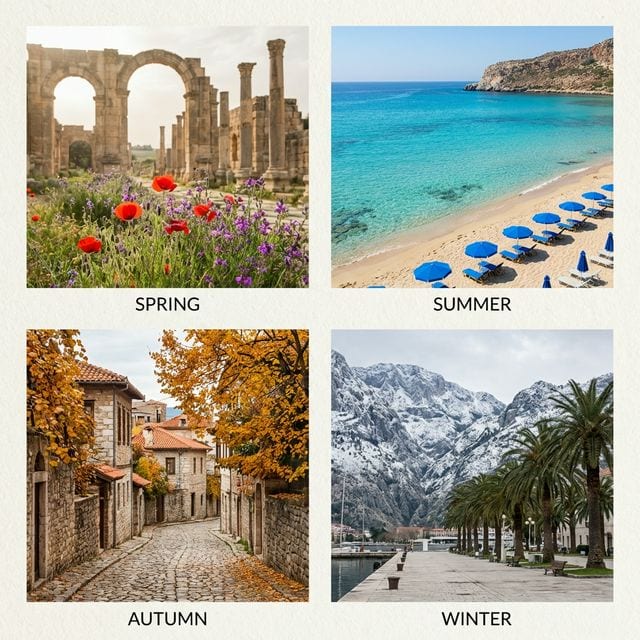
Winter (Dec–Feb): a proper rain jacket, layers, and closed shoes — Antalya's rain arrives in short, heavy bursts rather than steady drizzle. Shoulder months (Mar–May, Sep–Oct): light layers for morning and evening, sun protection for midday. Summer (Jun–Aug): minimal clothing, strong sunscreen, and something to cover shoulders for mosque visits — the heat is dry but relentless, and the sun at this latitude burns fast even under cloud.
Planning your trip?
Enter your exact route and vehicle type to see the current booking price before confirmation.
Getting From the Airport, Whatever the Season
Weather doesn't really change how you get from Antalya Airport to your hotel, but it changes what you want that ride to look like. In August, you want air conditioning waiting the second you step outside and zero time spent hunting for a taxi rank in a packed arrivals hall. In January, you want a driver who already knows your flight might land late and isn't going to charge you for it or vanish.
That's the gap we built Turkey Transfer to close. Every transfer — Antalya, Dalaman, Bodrum, or Istanbul airport — is one fixed price per vehicle, not per seat, so a family of five in a Mercedes V-Class or Vito pays the same as it would for two people. We track your flight in real time, so a delay doesn't strand you, and a driver is waiting inside the terminal with your name on a board — no lot to find, no app to fumble with after a long flight. Child and booster seats are free on request, we're TURSAB-licensed, and cancellation is free up to 24 hours out if your dates shift. We've run more than 50,000 of these transfers and hold a 4.9-star average, across a fleet that ranges from E-Class sedans to full-size Sprinters for groups. If you've settled on your month, book your ride on WhatsApp at +90 551 086 83 68 and we'll have a Mercedes waiting when you land.
FAQ
What is the best month to visit Antalya for both good weather and lower prices? May and late September hit that balance best — warm enough to swim, noticeably cheaper than July and August, and with far shorter lines at major sites like Aspendos and Kaleiçi.
Is the sea warm enough to swim in Antalya in April or November? Not comfortably. Sea temperatures sit around 18–19°C in April and roughly 20°C in November — swimmable for a quick, brisk dip, but most visitors wait for late May onward or stop by early October.
How many rainy days should I expect if I visit Antalya in winter? December and January each average around 12–14 rain days, usually as short, heavy downpours rather than all-day drizzle, with clear sunny stretches in between even in the wettest months.
Planning your trip?
Enter your exact route and vehicle type to see the current booking price before confirmation.