Antalya Airport to Side and Manavgat Private Transfer: The Complete 2026 Coastal Travel Guide
Somewhere between the pine-covered foothills of the Taurus Mountains and the turquoise curve of the Mediterranean, the road east out of Antalya Airport (AYT) settles into a rhythm that tells you exactly where you are headed. Greenhouses give way to citrus groves, citrus groves give way to pine forest, and then, without much warning, the first honey-colored columns of an ancient temple appear against the sea. This is the approach to Side and Manavgat — one of the richest short stretches of coastline in Turkey, where a functioning Roman port town sits inside a modern resort district, a waterfall roars a few kilometers inland, and the beaches on either side of a single peninsula behave like two completely different seas.
A private transfer from Antalya Airport to Side or Manavgat is not just a way to avoid a taxi queue. On a route this dense with things worth seeing — ruins, a canyon, a river, a waterfall, a golf belt, a rafting valley — the vehicle you choose for the first hour of your holiday genuinely shapes the rest of it. This guide goes deep on the journey itself, the ancient city of Side, the Manavgat Waterfall and river, the beaches, the resort belt, the best day trips, and the practical questions every traveler has before booking.
Quick Reference: Distances and Journey Times from Antalya Airport
| Destination | Distance from AYT | Approx. Drive Time |
|---|---|---|
| Side | 65 km | 70 minutes |
| Manavgat | 70 km | 75 minutes |
| Aspendos | 50 km | 45 minutes |
| Köprülü Canyon | 90 km | 90 minutes |
| Green Canyon | 80 km | 75 minutes |
| Titreyengöl | 85 km | 80 minutes |
| Sorgun | 75 km | 75 minutes |
| Kumköy | 70 km | 70 minutes |
| Belek | 34 km | 35 minutes |
| Kadriye | 30 km | 35 minutes |
| Route within the region | Distance | Approx. Drive Time |
| --- | --- | --- |
| Side to Titreyengöl | 26 km | 29 minutes |
| Side to Sorgun | 13 km | 14 minutes |
| Side to Kumköy | 16 km | 18 minutes |
The Journey: What the AYT to Side/Manavgat Drive Actually Looks Like
The route out of Antalya Airport toward Side and Manavgat runs primarily along the D-400, the coastal highway that traces the Gulf of Antalya eastward. It is a well-maintained, mostly dual-carriageway road, and for the first 30 kilometers or so it cuts through Antalya's eastern districts and the greenhouse belt around Aksu and Serik, where a huge share of Turkey's export tomatoes and peppers are grown under kilometers of plastic cover. It is not a glamorous first impression, but it does not last long.
Past Serik, the landscape changes. The greenhouses thin out, pine and eucalyptus start lining the road, and you begin passing the turnoffs for Belek's golf resorts — Turkey's most concentrated golf destination, home to venues used on the European and Challenge Tours. If your trip includes golf, this is also the point where a driver familiar with the Belek golf resort corridor matters, since clubs and travel bags need careful handling and many resorts sit down long private access roads that a standard taxi driver will not know without directions.
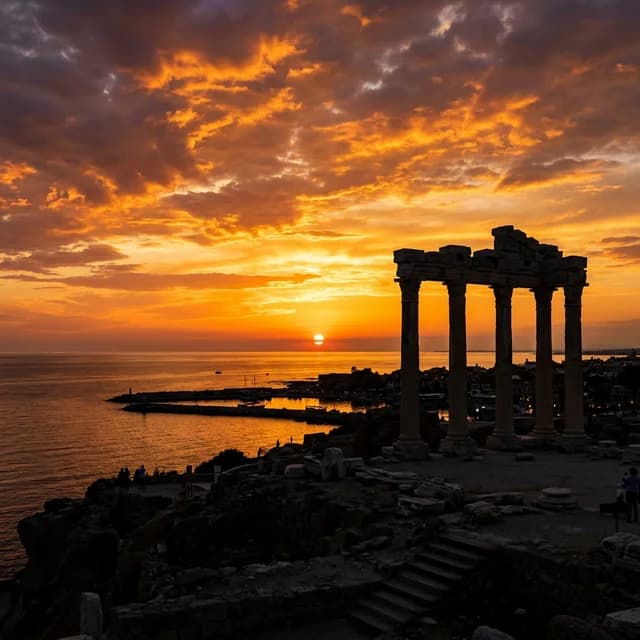
Continuing east, the road runs close enough to the coast that the sea appears and disappears between developments, and roughly an hour after leaving the airport, the first ruins of ancient Side become visible — a temple silhouette right at the tip of a small peninsula, framed by open water on three sides. It is one of the more striking "arrival" views on the Turkish coast, and one reason many travelers ask their driver to slow down or stop briefly for photos as they enter town.
Traffic Patterns and Best Times to Travel
Traffic on the AYT–Side/Manavgat corridor is generally light to moderate outside of two predictable windows: the midday arrivals bank at Antalya Airport (roughly 11:00–15:00 in peak summer, when dozens of European charter flights land close together) and the early evening return period around 17:00–20:00, when day-trippers head back from Manavgat's river restaurants and Side's beaches toward Antalya city and Belek. Summer weekends can also see a slowdown around Manavgat town center itself, where the road narrows near the river bridge and the Friday market draws heavy local traffic. None of this changes total journey time dramatically — even at its worst, this is not an hours-long crawl — but it is the difference between a smooth 70-minute ride and a 95-minute one. A private transfer service that tracks your flight and adjusts pickup timing accordingly is the simplest way to sidestep this variability entirely.
What a Private Transfer Driver Actually Handles
The practical value of booking ahead rather than queuing for a taxi on arrival comes down to a handful of concrete things:
- Flight monitoring: the transfer company tracks your actual landing time, not your scheduled one, so a delayed flight does not mean a missed pickup or a driver charging extra for the wait.
- Meet and greet: a driver waits inside the terminal with a name board, walks you to the vehicle, and helps with luggage — useful after a long flight with children or heavy bags.
- Child seats: for families, proper forward-facing or booster seats can be requested in advance and are fitted before you land, rather than improvised at the curb.
- Fixed, per-vehicle pricing: the fare covers the whole car, not each seat, so a family of four or a group of friends pays the same as a solo traveler taking the same vehicle — the pricing itself is quoted on request rather than published as a flat number, since it depends on vehicle size and exact pickup point.
- Direct route, no detours: unlike a shared shuttle, a private vehicle goes straight from the airport to your hotel door, with no stops to drop off other passengers first.
That last point is worth dwelling on, because it is the single biggest practical difference between a private transfer and a shuttle bus on this particular route. Side and Manavgat cover a wide geographic spread — Side old town, Kumköy, Sorgun, Titreyengöl, and Manavgat center are all technically "the same destination" on a shuttle company's map, but they can be 20+ km apart. A shared shuttle that serves all of them will stop at every hotel along the way before reaching yours, which on a bad day turns a 70-minute drive into two hours or more. A private vehicle skips straight to your address.
Side Ancient City: Turkey's Only Modern Town Built Inside a Roman City
Side (pronounced "SEE-deh") is unusual even by Turkish standards, because it is not a ruin you visit from a nearby town — the modern town is built directly among the ruins. Restaurants sit beside collapsed Byzantine walls, souvenir stalls operate in the shadow of a Roman gate, and the road into the peninsula runs straight past a 2nd-century monumental gateway before you have even parked the car. For a deeper single-destination dive into this area, see this private transfer guide to Side old town.
Temple of Apollo
The Temple of Apollo is Side's signature image and one of the most photographed ruins on the Turkish coast. Built in the 2nd century AD in the Corinthian order, it originally had eleven columns along its long sides and eight across the front, though far fewer stand today — five re-erected columns with their elaborate capitals now mark the site, positioned right at the tip of the peninsula with open sea on both sides. The temple was likely dedicated to Apollo and Athena together, reflecting Side's identity as a prosperous trading port under Roman rule, when the city's wealth came largely from its harbor and, in earlier centuries, from a slave market that made it notorious in the ancient Mediterranean.
The single best piece of practical advice for visiting: come at golden hour, in the final ninety minutes before sunset. The temple faces west over open water, and the low sun turns the limestone columns amber while silhouetting them against the sea — it is objectively the best light of the day for this specific spot, and it draws a steady but rarely overwhelming crowd of photographers, couples, and travelers timing their evening walk to end there. Midday visits are functional for seeing the site, but the light is flat and the heat in July and August can be intense with no shade at the exposed tip of the peninsula.
Side Roman Theatre
A short walk from the harbor stands one of the best-preserved Roman theatres in Anatolia, built in the 2nd century AD to seat an estimated 15,000–20,000 spectators — an enormous capacity that reflects Side's importance as a regional city rather than a minor provincial town. Unusually, the theatre was not cut into a hillside in the traditional Greek style; because Side sits on relatively flat coastal terrain, the structure was built up on a system of vaulted substructures, an engineering approach that required significantly more stone and labor than a hillside theatre would have. Much of the stage building (scaenae frons) survives, along with tiered seating that visitors can still climb for a wide view back over the old town's rooftops toward the temple and the sea. In later centuries the theatre was repurposed, first as a fortified refuge during Arab raids in the early medieval period and later, for a time, as an open-air venue for gladiatorial-style spectacles adapted from the Roman tradition. Today it remains one of the largest and most complete Roman theatres anywhere on Turkey's southern coast.
Side Museum
Side Museum occupies a genuinely unusual building: a restored 2nd-century Roman bath complex, with the exhibition halls arranged through the original frigidarium, tepidarium, and other bathing chambers rather than a purpose-built museum shell. The collection focuses on statuary, sarcophagi, and architectural fragments excavated from the ancient city — including well-preserved depictions of Roman gods, portrait busts, and decorative reliefs recovered from the theatre and agora. Because the museum is compact and shaded, it is a practical midday stop when the outdoor ruins get too hot, and it gives useful context (inscriptions, findspots, dating) that makes the temple and theatre more meaningful once you walk back out among them.
Ticket and Entry Practicalities
Side's main sites — the temple area, the theatre, and the museum — each generally require separate entry, and the temple/harbor area itself is largely open and walkable as part of the town rather than a single gated archaeological park. Turkey's Museum Pass (Müzekart) programs typically cover major sites like the theatre and museum, which can be worth checking if you plan to visit several ancient sites during your stay, including Aspendos or Perge. Opening hours shift seasonally, generally longer in summer and shorter in winter, and the theatre in particular can close earlier than the open-air temple area. Rather than quote fixed hours or numbers that change year to year, the practical approach is to confirm current hours locally on arrival — hotel front desks and transfer drivers based in the area typically know the current schedule.
Manavgat Waterfall: A Short Detour with a Big Payoff
Manavgat Waterfall is not a dramatic single-drop cascade — it is a wide, low, horseshoe-shaped falls where the Manavgat River spreads out and tumbles over a broad rock shelf, more powerful in its sheer volume of water than its height. What makes it worth the short detour from the town center is the atmosphere around it: mature trees shade the riverbanks, walking paths and viewing platforms run along both sides, and the roar of the water combined with the cooler, misted air makes it a genuinely pleasant break from the coastal heat, even in the middle of summer.
A cluster of riverside restaurants and tea gardens sits right along the falls, many built on wooden platforms extending out over the water, serving grilled fish, traditional Turkish breakfast spreads, and the region's excellent fresh-pressed orange and pomegranate juice. It is an easy, low-effort outing — flat paths, no significant walking distance, and enough shade and seating that it works well for a mixed group including grandparents and small children.
Accessibility is straightforward: the falls sit just a few kilometers from Manavgat town center and are typically visited as part of a half-day loop that also includes a walk through the town's old bazaar streets or a boat trip on the river itself.
Planning your trip?
Enter your exact route and vehicle type to see the current booking price before confirmation.
Manavgat River Boat Trips
The Manavgat River is one of the few rivers in this part of Turkey that supports a full day of leisure boating rather than just rafting, and cruises typically depart from near the waterfall or from jetties closer to Manavgat's town bridge. A typical river trip moves slowly upstream past orange groves, banana plantations, and dense riverside greenery that feels distinctly different from the arid coastline just a few kilometers away, often stopping at a riverside restaurant for a swim break or lunch before returning. Because the river is calm rather than fast-moving in its lower stretches, these boat trips are a relaxed, family-friendly activity — a contrast to the whitewater rafting available further inland at Köprülü Canyon. Many travelers combine the waterfall visit and a river cruise into a single half-day outing, since both are close together and neither requires a full day to enjoy properly.
Side Old Town and Harbour
Beyond the ancient monuments, Side's old town is simply a pleasant place to walk. The peninsula's narrow pedestrian streets are lined with shops selling leather goods, jewelry, ceramics, and textiles, interspersed with harbor-front cafés where the working fishing boats and pleasure yachts sit side by side. Much of the old town is genuinely pedestrianized, which makes it comfortable to explore on foot without worrying about traffic — a rarity in Turkish coastal towns.
The Side Night Bazaar is the old town's evening centerpiece, running along several of the central streets after the day's heat has faded. Stalls and shop-fronts stay open late, and the atmosphere shifts from a daytime archaeological site to a lively market town, with the illuminated temple columns visible in the background from several vantage points along the harbor. It is a good stop for souvenirs — Turkish towels, spices, ceramics, evil-eye ornaments — though as with markets anywhere, prices are more flexible for those willing to negotiate.
For dining, the harbor-front restaurants specialize in fresh Mediterranean seafood, often displayed on ice at the entrance so you can choose your fish before it is grilled, alongside the usual mezze spread of hummus, ezme, and stuffed vine leaves. Away from the harbor, quieter side streets have smaller, family-run restaurants with better value and fewer tourist-menu markups.
Beaches of Side and Manavgat: East, West, and Beyond
| Beach / Area | Character | Best For |
|---|---|---|
| Side East Beach | Long, sandy, shallow entry | Families with young children |
| Side West Beach | Shorter, quieter, sunset-facing | Couples, evening atmosphere |
| Kumköy | Quiet, residential, close to old town | Families wanting a calmer base |
| Titreyengöl | Upscale, lagoon-adjacent resorts | Resort-focused stays |
| Sorgun | Pine forest, shaded, nature-oriented | Travelers wanting shade and quiet |
Where to Stay: Side Old Town vs. the Resort Belt
Choosing a base in this region generally comes down to one decision: stay inside or near Side's old town, or stay in one of the resort villages spread along the coast to either side.
Side old town puts you within walking distance of the temple, theatre, harbor, and night bazaar, and the atmosphere in the evening — narrow lit streets, the sound of the sea, restaurants spilling onto the pavement — is hard to replicate elsewhere. The trade-off is that old town accommodation tends to be smaller boutique hotels and guesthouses rather than large all-inclusive resorts, and the streets can feel busy and touristic in peak season.
Kumköy, Sorgun, and Titreyengöl offer the opposite trade-off: larger resort properties, often all-inclusive, with more space, pools, and organized activities, at the cost of needing a short transfer into Side old town for the historical sites and nightlife. Sorgun in particular suits travelers who want shade and a quieter, forest-backed setting. Titreyengöl leans more upscale and self-contained. Kumköy sits in between — close enough to old town for an easy taxi or short transfer, but with its own quieter beach and a more residential feel.
Neither option is objectively better; it depends on whether the priority is walkable history and nightlife or resort comfort and space. Many travelers who stay in the resort belt still plan at least one evening specifically around dinner and the night bazaar in Side old town, using a short private transfer from Side to Titreyengöl, Side to Sorgun, or Side to Kumköy rather than relying on local taxis, especially late in the evening.
Best Time to Visit Side and Manavgat
The region follows the broader Antalya coast's Mediterranean climate pattern: hot, dry summers and mild, wetter winters, with the sea warm enough for swimming from roughly May through October.
April to early June brings comfortable daytime temperatures, green landscapes still carrying spring rainfall, and noticeably thinner crowds at the ancient sites — this is arguably the best window for anyone prioritizing comfortable sightseeing over beach time, since walking around the exposed Temple of Apollo site in July heat is a very different experience from doing it in May.
July and August are peak season in every sense: hottest weather, warmest sea, busiest beaches, and the fullest resort occupancy. The upside is the liveliest atmosphere in the old town and the most reliable beach weather; the downside is heat that makes midday ruin-walking uncomfortable and higher demand across accommodation and activities.
September and October offer a strong middle ground — sea temperatures stay warm well into autumn, crowds thin noticeably after the European school-summer period ends in early September, and daytime heat becomes more manageable, particularly by mid-October.
November through March sees the region quiet down considerably. Many resort-style hotels reduce operations or close seasonally, and while the ancient sites remain open and are genuinely pleasant to visit without crowds, this is not beach weather, and the Manavgat Waterfall's surrounding restaurants and river-boat operators run on a reduced schedule.
Planning your trip?
Enter your exact route and vehicle type to see the current booking price before confirmation.
Family Travel Notes
Side and Manavgat work well as a family destination for several concrete reasons beyond the beaches. The ancient sites themselves are largely flat and walkable — the temple area, the harbor, and the old town streets do not require serious climbing, though the theatre's upper tiers do involve stepped seating that is more of a challenge with a stroller. East Beach's long, shallow shoreline is specifically well suited to younger children who are not yet strong swimmers, and Manavgat Waterfall's flat paths and shaded seating make it an easy outing regardless of a family's mobility needs.
For the transfer itself, requesting a child seat in advance — rather than hoping one is available at the curb — is the single most useful piece of planning for families flying in with young children. A private transfer allows this to be arranged and fitted before the flight even lands, whereas a standard taxi rank will rarely have appropriate seats on hand. Larger families or groups traveling together also benefit directly from per-vehicle pricing: a minivan or larger vehicle costs the same whether it carries two people or six, which is a meaningfully different economics than paying per seat on a shared shuttle.
Evening Atmosphere and Nightlife
The character of an evening in this region depends entirely on where you are standing. Side old town has the most going on after dark — the Night Bazaar draws steady foot traffic, harbor restaurants stay animated well past sunset, and several bars and clubs near the harbor cater to a livelier crowd, particularly in peak summer months. It is not a large-scale nightlife hub on the scale of some other Turkish resort towns, but it has a genuine buzz.
Manavgat town center, away from the tourist beaches, has its own quieter evening rhythm centered on the riverside restaurants near the waterfall and bridge — a more local, less touristic atmosphere, good for a relaxed dinner rather than a night out.
The resort belt — Kumköy, Sorgun, Titreyengöl — is quieter after dark by design. Evenings there tend to center on hotel entertainment programs, beachfront restaurants, and calmer walks along the shore, which suits travelers who came for rest rather than nightlife. This contrast is worth factoring into where you choose to stay: if evenings out in a lively old town matter to your trip, basing yourself in or very near Side old town, or planning transfers in for specific evenings, makes more sense than assuming a resort-belt hotel will have that same atmosphere on-site.
Day Trips from the Side and Manavgat Base
Side and Manavgat's location makes it a genuinely strong base for day trips inland, not just a beach stop.
Aspendos
Aspendos is home to one of the best-preserved Roman theatres anywhere in the world — not a ruin requiring imagination to picture its original form, but a structure so intact it is still used today for a major annual opera and ballet festival, with acoustics good enough that performers can be heard clearly from the topmost seats without amplification. At roughly 50 km and 45 minutes from Antalya Airport, and considerably closer from a Side base, it pairs naturally with a Side/Manavgat stay, and many travelers combine it with Perge into a single archaeological day out.
Köprülü Canyon
Roughly 90 km and 90 minutes from the airport (and closer from Side), Köprülü Canyon is the region's premier whitewater rafting destination, with rapids running through a dramatic gorge of the Köprüçay River, framed by pine forest and ancient Roman bridges. Rafting trips here range from gentle family-friendly floats to more energetic whitewater sections depending on the season and water level, and many operators pair the rafting with a jeep safari through the surrounding national park. For full detail on planning this trip, see this Köprülü Canyon rafting day trip guide.
Green Canyon
Green Canyon, roughly 80 km and 75 minutes from the airport, is a reservoir lake on the Manavgat River known for its striking turquoise-green water color, framed by steep, forested canyon walls. Boat trips here are the main draw — slower-paced and more scenic than rafting, with swimming stops along the way — making it a good complement to the more adrenaline-focused Köprülü Canyon trip. See this Green Canyon boat trip guide for planning details.
A Sample Three-Day Itinerary from a Side Base
For travelers wanting a concrete shape to a trip based in Side or Manavgat, this loose structure covers the region's highlights without over-packing any single day.
Day 1 — Arrival and Old Town: Private transfer from Antalya Airport directly to your hotel. Spend the afternoon settling in and, once the day's heat eases, walk the old town toward the Temple of Apollo, timing arrival for the last hour before sunset. Dinner at a harbor-front restaurant, followed by a walk through the Night Bazaar.
Day 2 — Manavgat and the River: Morning visit to the Side Museum before the day heats up, followed by a short transfer to Manavgat Waterfall and a riverside lunch. Afternoon river boat trip, then return to the coast for a swim at East or West Beach before the evening.
Day 3 — Inland Day Trip: A full day out to either Aspendos and Köprülü Canyon together (both accessible on the same inland route) or a dedicated Green Canyon boat day, depending on whether the priority is ancient history and rafting or a slower scenic outing. Return to Side for a final evening at whichever beach — East for a lively last night, West for a quieter sunset — best matches the mood of the trip.
This structure can easily extend to a longer stay simply by adding beach days, a Belek golf excursion, or a further day trip toward Kemer or Göynük's mountain-and-beach combination, covered in more detail in this Kemer and Göynük transfer guide.
Planning your trip?
Enter your exact route and vehicle type to see the current booking price before confirmation.
Why Choose a Private Transfer Over a Shuttle or Regular Taxi
It is worth being specific about what actually separates a private transfer from the alternatives, rather than treating this as marketing language.
Versus a shared shuttle: a shuttle bus serves multiple hotels across a wide area — potentially Side old town, Kumköy, Sorgun, and Titreyengöl on a single run — which means your journey time depends on how many other passengers are dropped off before you, and in what order. A private vehicle goes directly to your address with no intermediate stops, which on this particular route, given how spread out the resort villages are, can save well over an hour compared to a shuttle serving the full area.
Versus a regular taxi rank: airport taxi ranks in peak arrival periods can mean a genuine wait, with no guarantee of vehicle size, condition, or a driver who speaks much English. A pre-booked private transfer is waiting for you by name, with the vehicle size and any child seats already arranged, and the fare agreed in advance rather than negotiated or metered — pricing is quoted on request based on vehicle type and distance, with no surprises at the destination.
Flight delays: a private transfer service that monitors your actual flight status adjusts pickup time automatically if your flight is late, at no extra cost. A taxi rank has no such flexibility, and a shuttle service running on a fixed schedule may simply have already departed.
Late-night and early-morning arrivals: for flights landing after midnight or before dawn — common with many European charter routes into Antalya — a private transfer arranged in advance guarantees a driver will be there regardless of the hour, which is far from certain with an unbooked taxi at an airport that can be quiet overnight. This is covered in more depth in this guide to night arrivals at Antalya Airport.
Group and family value: because pricing is per vehicle rather than per seat, a family or group of friends traveling together gets one fixed cost for the whole journey, regardless of how many people are in the car, which is structurally different from a shuttle or per-person taxi arrangement.
For a broader look at the Side/Manavgat/Kumköy corridor specifically, this transfer guide covering Side, Manavgat, and Kumköy together and this Riviera-focused transfer overview both go into further route-specific detail.
Frequently Asked Questions
How long does a private transfer from Antalya Airport to Side take?
Around 70 minutes under normal traffic conditions, covering approximately 65 km along the D-400 coastal highway. During the midday arrivals peak in July and August, or if there is congestion near Manavgat's town bridge, this can stretch to closer to 90 minutes, which is why flight-tracked pickup timing matters more than the raw distance figure.
Is a private transfer more expensive than a shared shuttle?
Pricing depends on vehicle size, exact pickup and drop-off points, and current demand, so it is always quoted on request rather than published as a fixed number. What is worth understanding is the value comparison: a private transfer is priced per vehicle, not per person, so for a family or small group the effective per-person cost is often comparable to or better than a shared shuttle, while delivering a direct door-to-door journey with no intermediate stops.
Can I request a child seat for the transfer?
Yes. Child and booster seats can be requested when booking, and a private transfer allows this to be arranged and fitted before your flight lands, rather than relying on availability at an airport taxi rank, where appropriate child seats are often simply not on hand.
What is the difference between Side East Beach and West Beach?
East Beach is longer with a gently shelving, shallow shoreline, making it the better choice for families with young children, and it is lined with resort hotels. West Beach is shorter, generally quieter, and directly faces the sunset, making it the preferred spot for an evening walk or a quieter swim, with fewer large resort operations directly on the sand.
How much time should I budget for visiting the Temple of Apollo and Side Roman Theatre?
A relaxed visit to both, plus a walk through the old town, typically takes half a day. Many travelers specifically time their temple visit for the final hour before sunset for the best photography light, then continue on to dinner and the Night Bazaar afterward, effectively turning it into an evening rather than a rushed midday stop.
Is Manavgat Waterfall worth visiting if I am staying in Side?
Yes, and it pairs naturally with a river boat trip on the Manavgat River. The waterfall itself is a short, flat, shaded outing rather than a demanding hike, and the riverside restaurants around it make it easy to combine with lunch. It is a good half-day addition to a Side-based stay rather than a destination requiring its own overnight base.
What is the best base: Side old town, Kumköy, Sorgun, or Titreyengöl?
Side old town suits travelers who want walkable access to the ruins, harbor, and Night Bazaar, with a livelier evening atmosphere but smaller boutique-style accommodation. Kumköy, Sorgun, and Titreyengöl suit travelers who prioritize larger resort properties, more space, and a quieter evening atmosphere, with a short transfer needed to reach Side's historical core and nightlife.
Can I combine a Side/Manavgat stay with day trips to Aspendos or Köprülü Canyon?
Yes, and this is one of the region's strongest advantages. Aspendos is roughly 45 minutes from the airport and considerably closer from a Side base, while Köprülü Canyon is about 90 minutes from the airport but a shorter drive from Side, making both very workable as single-day outings without needing to change accommodation.
Do I need to book separate tickets for the temple, theatre, and museum in Side?
Generally yes, as these are typically treated as separate sites rather than one combined ticket, though Turkey's Museum Pass programs often cover several major sites including the theatre and museum. Opening hours and ticketing details shift seasonally, so confirming current arrangements locally on arrival, through your hotel or transfer driver, is more reliable than relying on fixed information that may be out of date.
Is Side suitable for families with young children?
Yes. East Beach's shallow, gently sloping shoreline is well suited to younger swimmers, the old town's flat streets are stroller-friendly outside of the theatre's stepped seating, and Manavgat Waterfall offers an easy, shaded outing with minimal walking. Requesting a child seat for the airport transfer in advance is the main planning step families should not skip.
What is the best time of year to visit Side and Manavgat?
Late April through early June and September through October offer the best balance of warm weather, comfortable sightseeing conditions, and thinner crowds. July and August are hottest and busiest, best suited to travelers prioritizing beach time and lively evenings over comfortable midday ruin-walking. November through March is quiet, with many resort-style hotels reducing operations, but the ancient sites remain open and pleasant to visit without crowds.
How does a private transfer handle a delayed flight?
A private transfer service tracks your actual flight status rather than the originally scheduled time, and automatically adjusts the pickup accordingly at no extra charge. This is one of the more concrete practical advantages over an unbooked taxi rank, where a delay simply means a longer wait in a queue with no guarantee of vehicle availability.
Can a private transfer take me from Side to nearby resort areas like Titreyengöl or Sorgun after I arrive?
Yes. Short regional transfers such as Side to Titreyengöl, Side to Sorgun, and Side to Kumköy are commonly booked separately from the main airport transfer, useful for an evening out in Side old town while staying in the quieter resort belt, or for beach-hopping between the area's different coastal towns.
Side and Manavgat reward travelers who give them more than a single afternoon. The temple at sunset, the theatre's climb to the upper tiers, the waterfall's cool mist on a hot day, the contrast between a lively old-town evening and a quiet pine-shaded resort morning — none of it is rushed well from a bus schedule built around multiple hotel stops. Starting the trip with a direct, private transfer from Antalya Airport sets the tone for the rest of it: door to door, on your schedule, in a region that genuinely has enough packed into a small radius to fill a week without ever feeling repetitive.
Planning your trip?
Enter your exact route and vehicle type to see the current booking price before confirmation.