Antalya Yacht & Boat Tour Guide 2026: Gulet Cruises, Private Charter & Blue Cruise
There is a version of the Turkish Riviera that you simply cannot reach by road. It lives behind headlands where the tarmac gives up, in coves that only open from the water, along a coastline where Lycian rock tombs sit at eye level with the waterline and pine forest tumbles straight into water so clear it looks retouched. Antalya and its neighbouring harbours — Kemer, Side, Alanya, and further west toward Kaş and Fethiye — form the launch pad for one of the Mediterranean's richest boating cultures, built around the traditional wooden gulet, the small speedboat, the shared day-tour vessel, and the private charter yacht.
This guide is built for travellers who want more than a five-line brochure description. Whether you are weighing up a half-day group tour from Antalya's old harbour, planning a full week aboard a gulet on a classic Blue Cruise, or organising a private charter for a birthday or proposal, the sections below walk through boat types, departure points, real itineraries, seasonal planning, family logistics, booking traps, etiquette, and — because getting to the water on time matters more than most people realise — how private transfer fits into the whole experience.
Boat Types Explained: Which One Actually Suits You
Not all "boat trips" are the same product, even when they're marketed with near-identical photos. The single biggest factor in how much you'll enjoy a day on the water is matching the boat type to your group, your tolerance for crowds, and your budget.
Shared (Group) Day Boats
These are the workhorses of Antalya's coastal tourism — mid-size motor vessels, often two decks, carrying anywhere from 40 to over 150 passengers on a fixed daily route with several swim stops, an onboard lunch, and usually music and a bit of animation in the afternoon. You buy a per-person ticket, board with strangers, and follow a schedule the crew controls.
The appeal is obvious: it is the cheapest way onto the water, and on a good boat with a sensible passenger cap, the atmosphere is genuinely fun — swimming stops in turquoise water, a barbecue lunch, foam parties or a DJ set on some afternoon-return sailings. The downside is equally obvious: you have zero control over route, timing, or noise level, and on the cheapest boats the passenger count can be pushed well past comfortable capacity. This is the category where vetting the operator matters most (more on that below).
Private Gulet Charter
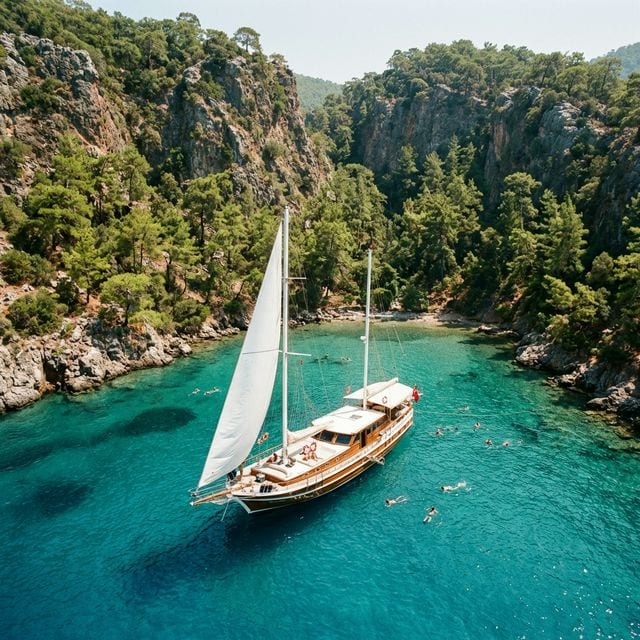
A gulet is a traditional twin-masted wooden sailing vessel, originally used for sponge diving and cargo along the Bodrum and Marmaris coasts, now built purpose-made for tourism. Chartering one privately — meaning the whole boat, crew, and route are yours for the day or for multiple days — is the single best way to experience the Turkish coast if your budget allows it.
A private gulet charter typically comes with a captain, a deckhand, and often a cook, all included in the charter rate. You set the route within reason (subject to weather and the captain's local knowledge), choose your swim stops, control the music, and decide when lunch happens. For families, couples, or groups of friends who want a boat trip without sharing it with eighty strangers, this is the category to look at, and it scales from a single day to a full multi-day Blue Cruise.
Speedboats
Smaller, faster, and far more manoeuvrable than a gulet, speedboats are chartered either privately for a half day of cove-hopping, or as part of a mixed-day tour where a larger mothership anchors and speedboats ferry guests to sights a bigger vessel can't reach — sea caves, narrow inlets, or the closer approach needed to properly see the sunken structures at Kekova. They're also popular for adrenaline add-ons: banana boat rides, towable tubes, wakeboarding, or simply the thrill of an open-water run at speed. Comfort is lower than a gulet — you're exposed to spray and sun, and seating is less generous — but for a shorter, punchier day trip, or for reaching spots inaccessible to bigger boats, they're an excellent option.
Catamarans
Twin-hulled and inherently more stable than a single-hull motor yacht or gulet of comparable size, catamarans have become increasingly common on the Antalya and Kemer charter scene. The wide, flat deck space is a real advantage for groups who want lounging area rather than narrow gulet decks, and the stability makes a noticeable difference for anyone prone to seasickness. Catamarans are available both as shared-tour vessels and private charters, and increasingly as the vessel of choice for sunset cruises given how much usable deck space they offer for group standing and mingling.
Luxury Motor Yachts
At the top end sit fully crewed motor yachts, generally 12 to 18 metres, offering higher-spec interiors, air conditioning, and a faster cruising speed than a gulet under sail or motor. These suit shorter, higher-comfort private charters — half-day or full-day — for guests who want yacht-club polish rather than the rustic wooden-deck character of a gulet. They are less commonly used for multi-day Blue Cruise itineraries, where the gulet remains the traditional and more practical choice.
Boat Type Comparison Table
| Boat Type | Typical Capacity | Privacy | Comfort Level | Best For | Typical Duration |
|---|---|---|---|---|---|
| Shared group day boat | 40–150+ guests | None (shared) | Basic to good, varies hugely by operator | Budget travellers, solo travellers, singles/groups wanting a party atmosphere | Half day or full day |
| Private gulet charter | 8–20 guests | Full privacy | High, traditional wooden character | Families, couples, friend groups, celebrations | Full day to multi-day |
| Speedboat | 4–10 guests | Full or shared | Moderate, more exposed to elements | Cove-hopping, adrenaline seekers, shorter trips | 2–5 hours |
| Catamaran | 10–40+ guests (shared or private) | Full privacy on private charter | High stability, wide deck space | Sunset cruises, groups prone to seasickness, private events | Half day to full day |
| Luxury motor yacht | 6–12 guests | Full privacy | Highest, air-conditioned interiors | Special occasions, proposals, corporate outings | Half day to full day |
Departure Points Along the Antalya Coast
Where you set sail from shapes the entire day, and the character of each harbour is genuinely different.
Kaleiçi Old Harbour, Antalya
Tucked directly beneath the cliffs of Antalya's old town, Kaleiçi's harbour is the most central and most photographed departure point on this stretch of coast. Wooden gulets line the quay against a backdrop of Ottoman-era houses and the old city walls, and because it sits inside walking distance of most of Antalya's hotel zones, it is by far the most convenient option for travellers staying in the city centre. Parking near the harbour is limited and the old town's narrow lanes are pedestrian-heavy, which is exactly why a private transfer that drops you directly at the harbour entrance saves real time and stress compared to negotiating a taxi through Kaleiçi's cobbled streets on a tight morning schedule. The harbour itself is worth arriving early for regardless — cafés and viewpoints along the upper terrace give a superb vantage over the boats before you board.
Kemer Marina
Around fifty kilometres southwest of central Antalya, Kemer is the coast's dedicated marina town, purpose-built around yachting tourism with a large, modern marina, a promenade lined with restaurants, and considerably more boat operators per capita than Antalya itself. Kemer is the natural launch point for the Phaselis coast, the Three Islands, and much of the Olympos-direction itinerary, and it tends to have a slightly younger, livelier boat-trip scene, including the moonlight and foam-party sailings that run in high season.
Side
East along the coast, Side's harbour sits beneath the columns of the Temple of Apollo, arguably the most cinematic backdrop of any departure point on this list. Boat trips from Side lean toward the Manavgat River route — a calmer, more scenic cruise upriver past waterfalls and riverside restaurants — as well as coastal day trips toward Alanya's pirate-ship-style vessels. It's a gentler, more family-oriented harbour scene than Kemer.
Alanya
Further east again, Alanya has built a genuine boat-tour identity around its fleet of pirate-ship replica vessels that circle the peninsula beneath Alanya Castle, stopping at sea caves along the way. It's a longer transfer from central Antalya — worth reading through the practicalities of the Antalya to Alanya route if you're planning the trip as a day excursion rather than staying in the area.
Classic Day-Trip Routes in Detail
Antalya Bay and the Waterfalls
A shorter, gentler route that leaves directly from Kaleiçi and threads along the base of Antalya's dramatic Beydağları cliffline before turning toward the mouth of the Lower Düden Waterfall, where fresh water plunges directly into the sea — a striking, almost surreal sight best appreciated from a boat sitting just off the cliff face, close enough to feel the spray. This route rarely runs longer than a half day and is popular as a sunset cruise option too, since the light on the cliffs in the late afternoon is exceptional for photography — a scene that regularly turns up on lists of the best Instagram-worthy spots around Antalya.
Kemer–Phaselis: Three Ancient Harbours
One of the most historically rich routes on the coast. Phaselis was a Lycian-then-Roman port city built around three natural harbours, and its ruins — a paved main street, an amphitheatre, an aqueduct — sit directly behind a series of beaches with the kind of clear water that makes swimming among ancient stone genuinely memorable. Boats from Kemer typically anchor off one of the three bays for a swim stop before continuing, and many travellers pair the sea approach with a land visit to walk the ruins properly; the archaeological detail is covered thoroughly in our guide to ancient ruins day trips around Antalya, including Phaselis.
Olympos–Çıralı Coast
Further southwest, the coastline around Olympos and Çıralı combines another set of Lycian ruins with the famous Chimera — natural flames that burn continuously from vents in the rock, fed by underground gas. Boat trips along this stretch tend to run longer, sometimes as a full-day charter given the distance from Antalya or Kemer, and pair naturally with the beach and treehouse culture that has made Olympos-Çıralı one of the coast's most laid-back destinations, detailed in our dedicated Olympos, Çıralı and the Chimera guide.
Kekova: The Sunken City
Further west still, off the coast near Kaş, Kekova Island is where Antalya's boat-trip scene reaches its most atmospheric. Following a series of earthquakes roughly two thousand years ago, sections of the ancient settlement of Simena partially submerged, and today you can glide directly over the outlines of walls, staircases, and building foundations visible just beneath the surface. The bay is flanked by rock-cut Lycian tombs at the waterline and the ruins of Simena Castle above the small village of Kaleköy. Because Kekova is a protected archaeological site, swimming and anchoring are restricted in specific zones — a rule every reputable operator respects and explains before the boat gets close, and one worth knowing about in advance so it doesn't feel like an odd inconsistency mid-trip. Kekova sits far enough from Antalya that most visitors either take it on as a long day trip from the Kaş area or fold it into a multi-day Blue Cruise; if you're staying closer to Kaş or Kalkan, our guide on the Kaş and Kalkan region, including diving and boutique stays has the wider context for the area.
Suluada: The "Turkish Maldives"
A small, uninhabited island off the coast near Adrasan, Suluada has earned its nickname honestly — shallow turquoise water over pale sand gives it a genuinely tropical look that surprises first-time visitors to Turkey's Mediterranean coast. It's reachable as a longer day trip by speedboat or as a stop on certain gulet itineraries running the Kemer-to-Kaş direction, and because there's minimal shade and no real infrastructure on the island itself, it rewards travellers who pack sun protection seriously and treat it as a swim-and-relax stop rather than a full-facility beach day.
Route Comparison Table
| Route | Typical Departure Point | Trip Length | Highlight | Best Suited For |
|---|---|---|---|---|
| Antalya Bay & Waterfalls | Kaleiçi Harbour | Half day / sunset | Düden Waterfall meeting the sea | Short stays, photography, sunset cruises |
| Kemer–Phaselis | Kemer Marina | Half day / full day | Three ancient harbours, swimming among ruins | History lovers, families |
| Olympos–Çıralı | Kemer / Adrasan | Full day | Lycian ruins, Chimera flames nearby | Longer day trips, nature-focused travellers |
| Kekova Sunken City | Kaş / Demre area | Full day or multi-day leg | Submerged ancient city, Simena Castle | Culture and history travellers, Blue Cruise itineraries |
| Suluada Island | Adrasan / Kemer | Full day | Shallow turquoise "Maldives" water | Beach and swim-focused travellers |
| Manavgat River | Side | Half day | Calm river cruise past waterfalls | Families, relaxed pace, non-swimmers |
| Alanya Peninsula | Alanya | Half day | Sea caves, pirate-ship boats, castle views | Casual sightseeing, kids |
The Blue Cruise: What It Actually Is
The term "Blue Cruise" — Mavi Yolculuk in Turkish — describes a multi-day gulet voyage along the Turkish coast, typically stringing together a chain of the bays, ruins, and islands described above into a continuous itinerary of several days rather than a single outing. It is one of the defining Turkish travel experiences, and it's worth understanding properly before booking, because it differs meaningfully from a single-day boat trip in almost every respect.
Planning your trip?
Enter your exact route and vehicle type to see the current booking price before confirmation.
Typical Multi-Day Itineraries
A common structural pattern runs from the Olympos or Kemer area southwest toward Demre, Kekova, and Kaş, with each day covering a manageable stretch of coastline and closing with the boat anchoring in a sheltered bay for the night rather than returning to a marina. Longer versions extend the route further toward Kalkan and eventually Fethiye, which lets a week-long cruise realistically cover the whole Lycian coast — a stretch our Fethiye and Ölüdeniz guide covers in detail if you're arriving or departing from that end. Shorter three- or four-day itineraries typically focus on one section of coast rather than attempting the full run, prioritising more time in fewer bays over covering more distance.
Cabin Charter vs Full Boat Charter
There are two fundamentally different ways to book a Blue Cruise. A cabin charter means you book one cabin on a gulet that fills its other cabins with unrelated travellers or couples — effectively a shared multi-day cruise, priced per person, similar in spirit to a small cruise ship but on a wooden sailing vessel with perhaps four to eight cabins total. A full boat charter means your group — a family, a set of friends, a couple celebrating an anniversary — takes over the entire vessel, with the whole itinerary, pace, and daily rhythm built around your preferences alone. Cabin charters are the more budget-accessible route into the Blue Cruise experience and suit solo travellers or couples happy to share common areas with strangers; full charters suit groups that want privacy and control, and scale in comfort and price according to the size and finish of the gulet.
What's Typically Included, and What Isn't
Most gulet charters, whether cabin or full-boat, include the crew (captain, deckhand, and usually a cook), fuel for the planned route, and the main meals prepared onboard — breakfast, lunch, and dinner are typically part of the package, generally simple, fresh Turkish cooking built around whatever seafood and produce the crew sources along the way. What's typically excluded, or charged as an extra, includes alcoholic drinks beyond a modest house allowance (if any is included at all), soft drinks and bottled water in some cases, water sports equipment rental, and any land excursions that involve entrance fees to archaeological sites. Because inclusions vary significantly between operators and price tiers, this is the single most important thing to clarify in writing before you commit — see the booking pitfalls section below for how to do that properly. As with every price point in this guide, exact charter rates are on request and vary by season, boat size, and route length.
What to Pack for a Multi-Day Cruise
Storage on a gulet is limited, so a soft duffel bag rather than a rigid suitcase is strongly preferable — hard-shell luggage is a genuine headache to stow in the low cabin lockers typical of these boats. Beyond the obvious swimwear and reef-safe sunscreen, pack layers for the evening (nights at anchor can be noticeably cooler than the midday heat, especially outside the peak summer months), a light rain jacket if travelling in shoulder season, a hat with a chin strap for windy stretches, a dry bag for phones and cameras during swim stops, and any medication you take regularly, since pharmacies are not part of the daily itinerary once you're at anchor in a remote bay. A universal adapter is worth having even though most gulets run on standard Turkish sockets, and it's sensible to bring a portable power bank given the limits on onboard charging described below.
Sleeping on Deck vs Cabins, and the Realities of Life Aboard
Most gulets offer proper cabins below deck, generally compact with bunk or double beds and an en-suite shower/toilet, air-conditioned on higher-spec boats and reliant on natural ventilation on more traditional ones. Many travellers, especially in the height of summer, choose to sleep on deck instead — mattresses laid out under the open sky is one of the signature Blue Cruise experiences, and on a clear night with no light pollution the stars over open water are extraordinary. It's worth asking in advance whether deck sleeping is standard practice on your chosen boat and whether bedding is provided for it.
On the practical side: showers on gulets are functional but modest, freshwater tanks are limited, so quick showers are the norm rather than long ones, and it's common practice to rinse off with seawater after a swim before a brief freshwater rinse to conserve the tank. Wifi connectivity is inconsistent at best once you're away from populated harbours — some boats offer onboard wifi via mobile data packages that work reasonably well near the coast and drop out in more remote anchorages, so it is sensible to treat a Blue Cruise as a genuine digital break rather than expecting to stay reliably connected. Power outlets exist onboard for charging but are often limited in number and sometimes only available while the generator or engine is running, which is another good reason to bring a charged power bank.
A Typical Day on a Boat Trip
Whether it's a single-day shared tour or one day within a longer Blue Cruise, the daily rhythm on the Turkish coast follows a familiar and genuinely pleasant pattern.
Boarding usually happens between 9:30 and 10:30 in the morning, and punctuality matters — boats on fixed day-tour schedules will not wait for latecomers, since the whole route and the other passengers' day depend on departing on time. Once underway, the first hour or two is typically a scenic cruise toward the first anchorage, giving everyone time to settle, find a spot on deck, and take in the coastline. The first swim stop generally comes mid-morning in a sheltered, calm bay, and this is usually the longest and most relaxed swim break of the day.
Lunch is served onboard, generally around midday to early afternoon, and on most Turkish gulets and day boats this means a barbecue or grill service — fish, chicken, or meat depending on the operator, alongside salads, bread, and fresh fruit, all included in the price of the trip. It's a genuinely satisfying part of the day, and travellers curious about what to expect from Turkish coastal cooking more broadly will find useful context in our guide to Turkish food for tourists. After lunch, a second and sometimes third swim stop follows, often at a location chosen for snorkelling rather than just swimming — clear water over rock or reef where fish are easy to spot even without full gear. Divers and snorkellers planning a more serious underwater day should look at our dedicated guide to diving and snorkelling sites around Antalya, since several of the better sites are reachable specifically via boat trip rather than from shore.
The afternoon on shared day boats often shifts tone — music comes on, some operators run a foam party or simple dance session on the open deck, and the mood turns from quiet relaxation to a livelier, more social atmosphere before the final swim stop and the return leg. On private charters, this part of the day is entirely up to you: some groups keep it low-key with quiet conversation and a final swim, others treat it as the highlight and turn the deck into exactly the kind of party they came for. Return to harbour is typically mid-to-late afternoon on day trips, or continues into the evening on sunset cruise itineraries, which extend the day specifically to catch the light show as the sun drops behind the Beydağları mountains.
Best Months and Sea Temperature
| Month | Approx. Sea Temperature | Crowd Level | Notes |
|---|---|---|---|
| April | 17–19°C | Low | Boats running, water still cool for long swims; strong value season |
| May | 20–22°C | Low to moderate | Comfortable swimming begins; excellent light for photography |
| June | 23–25°C | Moderate | Warm, fewer crowds than peak summer, strong all-round choice |
| July | 27–28°C | High | Peak season, warmest water, busiest boats and harbours |
| August | 28–29°C | Highest | Warmest sea of the year, book well ahead |
| September | 26–27°C | High | Still very warm water, slightly thinner crowds than August |
| October | 23–24°C | Moderate | Comfortable swimming continues, pleasant temperatures onshore |
| November | 19–21°C | Low | Tail end of the season, fewer operators running full schedules |
Seasickness: Practical Tips That Actually Help
Seasickness can turn an otherwise wonderful day sour quickly, but it's manageable with a few sensible precautions.
If you know you're prone to motion sickness, take medication before boarding rather than after symptoms start — most seasickness tablets and patches work by preventing the inner-ear conflict that causes nausea, and they are considerably less effective once you already feel unwell. Scopolamine patches, applied behind the ear several hours before departure, are a popular option for longer trips precisely because they last the whole day rather than needing repeat dosing. Ginger, in tablet, tea, or candy form, is a genuinely useful mild remedy that many people find helps settle the stomach without drowsiness, and acupressure wristbands are a low-risk option worth trying if you prefer to avoid medication altogether.
On the boat itself, position matters. The middle of the vessel, low and near the centreline, moves the least; the bow and the stern both pitch more, and upper decks roll further than lower ones. Sitting outside in fresh air with a clear view of the horizon is far better than sitting below deck or staring at a phone screen — the visual horizon trick, keeping your eyes fixed on a stable, distant point rather than the moving deck or water close to the boat, genuinely helps recalibrate your inner ear. Avoid heavy, greasy food and alcohol before boarding, but don't sail on a completely empty stomach either — a light, plain meal a couple of hours before departure is the sensible middle ground. If you do start to feel unwell, moving outside, focusing on the horizon, and getting some fresh air is almost always more effective than retreating indoors.
Family and Kids on Boat Trips
Boat trips are genuinely popular with families in Antalya, but a little planning makes a big difference to how smoothly the day goes.
Life jackets are standard safety equipment on every reputable operator's boat and are provided in child sizes as well as adult ones — it's worth confirming child-size availability specifically when booking if you're travelling with a young child, since the smallest sizes can occasionally run short on busier boats. Age minimums vary by boat type: shared day boats with swim stops in open water are generally fine from around three or four years old provided a parent stays close, while speedboat trips with faster open-water running are usually better suited to children old enough to sit securely and follow safety instructions, typically from around six or seven upward depending on the operator's own policy. Private charters remove most of these constraints, since the pace, swim depth, and route are entirely adjustable to suit even very young toddlers or babies.
Shade is the single most overlooked family consideration — the sun on open water is stronger than it feels, reflecting off the surface as well as coming directly overhead, so a boat with a proper shaded deck area matters more for a family with small kids than almost any other feature. Sun hats, high-SPF sunscreen reapplied through the day, and swim shirts for young children are all worth packing regardless of how shaded the boat is. For entertainment, younger kids tend to be happiest with frequent swim stops and simple onboard games, while teenagers generally do better on trips with speedboat add-ons, snorkelling, or a livelier group atmosphere — families travelling with teens might find useful ideas in our guide to Antalya activities for teenagers. For the youngest travellers, getting to and from the harbour comfortably matters just as much as the boat itself, and our guide on family airport transfer with child seats and strollers covers the logistics of travelling with car seats and buggies across Antalya more broadly, much of which applies directly to the transfer leg of a boat-trip day.
Planning your trip?
Enter your exact route and vehicle type to see the current booking price before confirmation.
Booking Pitfalls to Avoid
The boat-trip market in Antalya is large and competitive, which is good for choice but also means quality varies enormously between operators offering superficially identical trips.
The most common problem is overcrowding on budget shared boats — a vessel rated for a certain capacity can, on paper, still legally carry that number, but a boat that feels comfortable at sixty guests feels miserable at a hundred and twenty. Ask directly what the passenger count will be on your specific sailing, not just the boat's maximum capacity, and treat a reluctance to answer clearly as a warning sign. Hidden extras are the second major trap: some of the cheapest advertised prices exclude items that feel like they should be included, such as beach towels, snorkelling equipment, or even water sports activities that are demonstrated in the marketing photos but charged separately onboard. The much-advertised "free bar" on some party-style boats is worth scrutinising closely too — in practice this sometimes means a limited house selection of local spirits mixed with soft drinks for a set window of time, rather than an open premium bar all day, and the difference matters if that's a deciding factor in your choice.
Before booking, it's worth checking recent reviews specifically for group size complaints, confirming in writing exactly what's included (meals, drinks, equipment, transfer), and asking how the operator handles bad weather cancellations or reschedules. Group size caps, in particular, are worth asking about directly rather than assuming — a well-run operator will tell you the actual number expected on your date without hesitation. Solo travellers and those newer to independent travel in Turkey may also find the general safety and vetting advice in our first-time Turkey visitor guide and our solo female travel guide useful background before finalising any tour booking, boat trips included.
Private Charter for Celebrations and Groups
A private charter is, in many ways, the most flexible product on this entire coast, and it comes into its own for occasions that deserve more than a shared, fixed-schedule tour. Birthdays, anniversaries, engagement proposals, corporate outings, and reunions all suit the format well, precisely because the route, timing, music, and menu can all be built around the occasion rather than fitted into someone else's schedule.
Most charter operators are used to customising the day on request: adjusting the route to prioritise a specific bay or sunset timing, building a menu around dietary preferences or a celebratory meal rather than the standard barbecue lunch, arranging simple deck decoration for a birthday or proposal, and coordinating a cake to be brought onboard and served at a chosen moment — a detail worth requesting well ahead of the sailing date rather than as a same-day addition, since it typically needs to be sourced and delivered to the boat before departure. For a proposal specifically, discussing the exact moment and location with the captain in advance (a quiet anchorage rather than a busy swim stop, for instance) tends to make a much bigger difference to how the moment actually plays out than any amount of onboard decoration. Corporate groups and larger reunions generally do best on a bigger gulet or catamaran with open deck space for standing and mingling rather than the more intimate cabin-focused layout of a smaller charter boat.
Sustainability and Etiquette on the Water
The Turkish coast's clarity and marine life are part of what makes these trips special, and keeping it that way depends on small, consistent choices by everyone who visits.
Reef-safe sunscreen — formulations without oxybenzone and octinoxate, the two chemical filters most strongly linked to coral and marine-life damage — is worth packing specifically for boat trips, since a boat full of guests reapplying conventional sunscreen before every swim stop adds up over a season. Avoid touching coral, rock formations, or marine life directly; even a light touch can damage slow-growing organisms, and standing on submerged structures is both damaging and, in protected areas, against the rules. Kekova is the clearest example of why this matters: because the sunken city is a protected archaeological site, there are designated no-anchor and no-swim zones directly over the most sensitive ruins, and respecting these — even when the water above them looks perfectly swimmable — is essential to preserving the site for future visitors. Reputable operators brief guests on these zones before arrival; treat any operator who doesn't as a red flag.
Waste management on gulets, especially multi-day charters, follows increasingly strict practice among reputable operators — solid waste is stored onboard and disposed of properly in harbour rather than at sea, and greywater discharge is regulated in sensitive anchorages. As a guest, the simplest contribution is straightforward: don't throw anything overboard, including cigarette butts and biodegradable-seeming items, and flag any plastic waste you generate for proper onboard disposal rather than assuming it will be handled invisibly.
On tipping: it's customary on Turkish boat trips, as in much of the country's service industry, to tip the crew for good service at the end of a trip, particularly on private charters where the captain and crew have spent the day looking after your group specifically. There's no single fixed rule for the amount, and it varies with trip length, group size, and service quality — our broader Turkey tipping guide covers the general etiquette and expectations across different service settings, most of which transfers directly to the boating context.
Private Transfer to the Marina: Getting the Logistics Right
Boat trips are one of the few tourist activities in Antalya where the departure time is genuinely non-negotiable. A gulet or day boat with forty other passengers aboard, or a private charter with a captain working to a planned route around tides, light, and weather, will not wait for a late arrival — and because most sailings leave between 9:30 and 10:30 in the morning, exactly the window when hotel breakfast service, checkout lines, and city traffic all overlap, the margin for error on the transfer leg is smaller than it looks on paper.
This is where the choice between a hotel shuttle, a taxi hailed on the spot, and a pre-booked private transfer actually matters. A hotel shuttle, where one exists, often runs on its own fixed schedule that may not align neatly with your boat's boarding window, and shared shuttles typically make multiple stops before reaching the harbour. A taxi hailed last-minute from a resort area during the morning rush can mean an unpredictable wait exactly when you can least afford one. A private transfer booked in advance for the specific pickup time your boat requires removes that uncertainty entirely — the driver knows the harbour, the drop-off point, and the fact that this trip has a hard deadline, and builds the route accordingly.
Distances from Antalya's main hotel zones to the harbours vary enough that they're worth planning around rather than guessing. From the airport, Antalya's own marina sits roughly 15 kilometres away, Kemer Marina around 50 kilometres, and the Side or Manavgat docks roughly 65 kilometres. From Lara Beach, the Antalya marina is a short run of around 10 kilometres, while Kemer is closer to 55 kilometres and Side around 60. From Belek, the Antalya marina and Side dock are both roughly 35 kilometres away, with Kemer further out at around 65 kilometres. None of these are long drives in isolation, but stacked against a fixed 9:30 boarding time and unpredictable morning traffic through Antalya or along the coastal road, the margin shrinks quickly — which is exactly why booking a private transfer timed specifically to your boat's departure, rather than working backward from a rough guess, is the safer approach for any boat trip that matters to you.
If your boat trip is the first leg of a multi-day Blue Cruise rather than a single-day outing, luggage handling adds another layer worth planning for. You'll typically be boarding with several days' worth of bags rather than just a beach bag, and a private transfer with proper luggage space removes the awkwardness of trying to fit multi-day baggage into a shared shuttle already carrying other passengers' day-trip gear. It's also worth timing this kind of transfer with a slightly wider buffer than a standard day-trip pickup, since boarding and stowing luggage for a multi-day charter naturally takes longer than stepping onto a day boat with a towel and sunscreen.
The return leg deserves the same planning, particularly after a sunset cruise. These trips are, by design, timed to return well after dark, at an hour when harbour taxi availability can be thinner than during the day, especially at smaller docks like Kemer or Side outside peak season. Arranging the return private transfer at the same time as booking the outbound leg — rather than trying to find transport at the harbour after a long day on the water — is a small piece of planning that removes one of the few genuinely stressful moments a boat-trip day can otherwise produce.
Planning your trip?
Enter your exact route and vehicle type to see the current booking price before confirmation.
Frequently Asked Questions
How far in advance should I book a boat trip or gulet charter in Antalya?
For a shared day boat in shoulder season (April, May, October), booking a day or two ahead is usually sufficient, since operators run frequent departures and rarely sell out completely. For July and August, or for any private charter regardless of season, booking at least a week ahead is strongly advisable, and for a multi-day Blue Cruise during peak summer, several weeks to a couple of months of lead time gives you access to the best boats and the widest choice of dates. Private charters for special occasions, where a specific date matters, benefit from the earliest booking window you can manage.
What's actually included in a typical boat trip price?
Most shared day trips include the boat, crew, a barbecue-style lunch, and access to the standard swim stops on the route. Private charters generally include the boat, captain, and crew as standard, with meals commonly included but sometimes offered as an add-on depending on the operator and trip length. Drinks beyond a basic soft-drink allowance, water sports equipment, and any land excursion entrance fees are usually separate. Because packages vary significantly, always ask for a clear written breakdown before paying, and expect prices themselves to be quoted on request given the range of boat types, group sizes, and seasons involved.
Is a private gulet charter worth the extra cost compared to a shared day boat?
It depends on what you value most. A shared day boat is the more economical route onto the water and, on a well-run operator with a sensible passenger cap, can be genuinely enjoyable and social. A private charter buys you control — over route, pace, music, food, and who else is on the boat — plus a noticeably higher comfort level and privacy that matters especially for families with small children, couples celebrating something specific, or groups who simply don't want to share their day with strangers. For a one-off special occasion, most travellers find the difference worth it; for a casual half-day out, a good shared boat is often plenty.
What should I pack for a single-day boat trip?
Swimwear, a reef-safe sunscreen, a hat, sunglasses with a strap, a light cover-up for the boat ride itself, a dry bag or waterproof pouch for your phone, a light towel if it isn't provided, and a change of clothes for the return journey. Cash in small denominations is useful for any onboard extras not included in the ticket price.
Can non-swimmers still enjoy a boat trip?
Yes. Life jackets are standard equipment, and no boat trip requires strong swimming ability — many guests simply float in shallow, calm water near the boat using a life jacket or a pool noodle, and the Manavgat River route from Side in particular suits non-swimmers well given its calmer conditions compared to open coastal water.
How rough does the sea typically get, and could a trip be cancelled for weather?
The Mediterranean along this stretch of coast is generally calm through the main boating season, particularly in the sheltered bays that most itineraries favour. Wind picks up on some afternoons, especially in shoulder season, and reputable operators will adjust the route or, in genuinely unsafe conditions, postpone or cancel a sailing entirely rather than risk guest safety. If your trip is weather-cancelled, ask about the operator's rescheduling or refund policy before booking so you know what to expect.
What's the difference between a Blue Cruise and a regular multi-day tour package?
A Blue Cruise specifically refers to a multi-day voyage aboard a traditional gulet, with the boat itself as both transport and accommodation, moving along the coast and anchoring in a new bay most nights. It's distinct from land-based multi-day tour packages that use boats only for day excursions between hotel stays — on a Blue Cruise, the boat is where you live for the duration of the trip.
Do I need a visa or any special documentation to go on a boat trip in Turkey?
No additional documentation beyond your standard travel documents for entering Turkey is required for a domestic boat trip or charter. Multi-day Blue Cruises don't cross international waters on standard coastal itineraries, so no separate immigration formalities apply.
Are boat trips suitable for travellers with limited mobility?
It depends heavily on the specific boat and operator. Larger day boats and catamarans generally have more manageable, wider walkways and fewer steep steps than smaller gulets, but boarding itself — often via a gangplank or ladder from a jetty — can be a genuine obstacle regardless of boat size. It's worth contacting the operator directly to describe your specific mobility needs before booking, since boarding arrangements and onboard layout vary enough that a blanket answer isn't reliable.
What happens if I get seasick and there's no way to end the trip early?
On shared day boats, if you feel unwell, tell the crew — most are experienced with seasickness and can offer a better seating spot, fresh air, or occasionally basic remedies onboard. On multi-day Blue Cruises, it's worth discussing seasickness history with the operator at booking stage, since some routes involve calmer, more sheltered stretches than others, and a captain can sometimes adjust anchorage choices with this in mind. Coming prepared with medication taken before symptoms start remains the most reliable prevention, as covered earlier in this guide.
Is alcohol available onboard, and is it safe to drink while swimming?
Many boats, particularly shared day tours with a party atmosphere, offer drinks including alcohol as part of the package or as a paid extra, and it's worth clarifying exactly what "included" means before boarding, as covered in the booking pitfalls section above. As a safety note, it's sensible to avoid swimming immediately after drinking alcohol, and reputable crews will generally discourage guests from entering the water if they appear significantly impaired, for straightforward safety reasons.
How does a private transfer to the harbour compare to using a hotel shuttle for a boat trip?
A private transfer is booked for your specific pickup time and destination, with no intermediate stops, which matters significantly given how strict boat departure times tend to be. A hotel shuttle, where available, often runs on its own schedule and may include stops at other properties before reaching the harbour, which introduces timing risk on a morning where being even fifteen minutes late can mean missing the boat entirely. For any boat trip with a fixed 9:30 or 10:00 boarding time, a private transfer removes that risk.
Can I combine a boat trip with other activities on the same day, like diving or a land excursion?
Yes, and it's common practice on certain routes. Boats heading toward well-known snorkelling or diving areas often build in extra time at those specific stops, and some operators run dedicated diving-focused day trips rather than general swim-and-sightseeing itineraries — worth checking our diving and snorkelling guide if underwater time is your priority rather than simply swimming. Combining a boat trip with a land-based ruins visit, such as Phaselis, is also common, either as part of the same day via a shore stop or as a separate excursion on another day of your stay.
Final Thoughts
Antalya's coastline rewards travellers who take to the water, and the range of ways to do it — from a budget shared day boat with a barbecue lunch and a foam party, through a private gulet for a family celebration, to a full week-long Blue Cruise tracing the Lycian coast from Olympos to Fethiye — means there's a genuine match for almost any traveller, budget, and occasion. The details matter more than they first appear: the right departure point for your hotel base, a realistic read on group size and inclusions before you book, sensible packing and seasickness precautions, and a transfer plan that respects just how strict boat departure times really are. Get those right, and the boat itself does the rest — turquoise water, ancient stone at the waterline, and a stretch of Mediterranean coastline that genuinely earns its reputation.
Planning your trip?
Enter your exact route and vehicle type to see the current booking price before confirmation.